Sucking Eggs

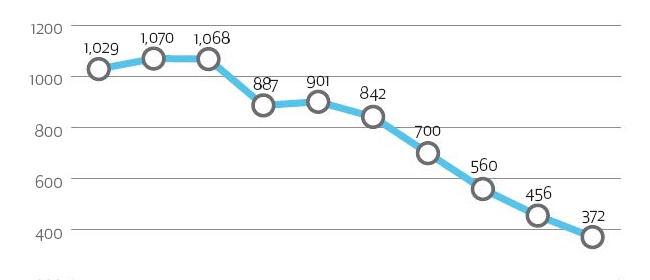
The constant decline in advertising revenue for magazine publishers is a worrying statistic that has not only seen the closure of iconic titles and long standing businesses, but also the departure of friends from the industry. In Australia we have experienced yearly ad expenditure reductions by up to 17% in some cases, and the percentage of adspend for magazines has been steadily dropping from a total of 9.4% in 2006 to 4.3% in 2013; according the the annual World Magazine Trends published by FIPP – the worldwide magazine media association.

Adspend

Australian Adspend by Sector – Click for larger image

As the head of Publishers Australia; a non-profit association that represents the leading Business to Business (B2B), Business to Consumer (B2C), Custom and Digital Publishers in the country; I have been advocating for several years now that magazine publishers should stop focusing so heavily on the printed page and concentrate on selling their entire package of magazine media. This includes physical assets such as events and traditional display advertising, as well as digital assets like social media and an effective web presence.

“Two of the main sources of internet growth are currently social media and online video. Social media is already 10% of internet advertising expenditure, and we expect it to grow 35% this year, while online video is at 8% of spend and is growing by 29%.”  Comment by Zenith Optimedia in FIPP’s World Magazine Trends 2013/2014 publication.

Multichannel advertising is the key!

Ok it may sound like I am teaching you how to suck eggs, but giving away your online presence in order to get a print ad across the line is just bad business. Print space has a cost in ink, paper, print, binding, distribution, etc. Online has a cost too, and it not just bandwidth. When putting a package together that includes a social media campaign, web presence and print ad, publishers need to start including a price per line item. Too often I see the tablet ad given away to get the print business. Far too frequently is Facebook provided free of charge when a client commits to a print run. The problem is, as your print ad revenue continues to decline you will want to start charging for those ‘giveaways’ and this will be very difficult to do for existing clients who are used to receiving it for free.

Online advertising is a growing market, as evidenced above, and mobile is the fastest growing internet channel of them all.

“Smartphone and tablet users have a clear appetite for high-quality content, and several immersive apps have shown that this is a demand that magazines can meet.” Comment by Zenith Optimedia in FIPP’s World Magazine Trends 2013/2014 publication.

Sales reps need to be given targets and publishers need to support their sales teams. Charge accordingly for every single channel you offer to your client. Develop packages that allow your client to choose what channels they wish to participate. Make these packages sound attractive with descriptive terms such as Gold, Silver and Platinum. If you need to offer a discount to close the business then offer that discount off the bottom line. Do NOT give away a single channel for free.

“Reports of my death have been greatly exaggerated” – Print Media

But it is not just publishers who need to change their way of thinking, media buyers need to take a fresh look at magazines. John Steedman, Chairman of GroupM and one of the most powerful advertising buyers in the country, stated recently that his business is actively encouraging clients to take a fresh look at magazines and newspapers. In Mr. Steedman’s opinion, “advertisers have been moving away from print faster than readership and circulation figures are actually falling; and the negativity around print has been overcooked.”

The Custom Publishing Report produced by Publishers Australia in 2011 showed that custom magazines are considered to be the most credible medium in reporting information about the relevant brand or organisation. Readers of custom magazines expect to see advertising in the magazines and will notice and read the advertising in these magazines.

A 2012 industry-wide survey of Australian magazine publishers indicated that nine in ten organisations (91%) expected the company’s total online revenue to grow, and that they were going to actively invest in digital platforms such as social media, web sites and tablet / mobile apps, to work alongside their print offerings.

New measurement metrics from EMMA, along with the established services from Roy Morgan, effectively track readership across print, web, tablet and mobile.

Advertising online offers several advantages over print. Viewing the latest SUV drive comparisons looks better in video than via printed statistics. However, the longevity of the printed product is well evidenced every day in medical waiting rooms, hotel suites, kitchen libraries and coffee tables everywhere, but it is now just one part of a multi-channel world.

I for one hope that print does not disappear in my lifetime. I love a new title and recent releases such as the Renegade Collective (a consumer title aimed at entrepreneurs) and Vet Practice (a custom title for animal healthcare professionals) have proven that the print is not dead. But the success of these titles lies not only in their ability to target a niche audience, but also in their marketing expertise and utilisation of the many different channels available to promote their publication.

New print publications are sustainable when combined with a multichannel approach to marketing and advertising, existing print publications should be too.


The Elephant in the Room

theelephant-logo5We recently had the pleasure of meeting John Hancock, CEO of EzyMedia and founding publisher of the new national magazine for social impact, The Elephant Magazine.

Tell us about The Elephant Magazine – what’s the story behind it?
The Elephant Magazine shares stories from enterprises, organisations and individuals working to make enduring differences in the lives of disadvantaged Australians.

I have pursued leverage for social change for all my working life, starting in child protection before I’d even finished university, moving into policy, business, microfinance and 10-years ago into media. I see media as a crucial and powerful tool for change, and The Elephant Magazine brings together that drive with a decade of publishing experience.

You’ve recently launched the website and you are looking to go to press this month. What’s it about and how can people support it?
The Elephant Magazine promotes the work of individuals, organisations and enterprises across Australia via a national print and digital magazine written by its readers, with an aim toward engaging greater investment and public participation in the social and environmental sectors.

People can support it by ordering a few print copies (shout a friend one!), spending $20 on a directory listing, $10 on a job listing, or a few more bucks on print/online/social media advertising packages. A 20% discount on everything applies to NGO’s, NFP’s and volunteers.
If none of this is within reach, someone can support the magazine simply by telling others about it, sharing articles via the social media share buttons, adding to your Facebook, following us on Twitter etc.

What are your future plans for The Elephant Magazine?
The idea is to crank it up fairly quickly here in Australia over the next 12-18 months, then replicate in US, Canada and UK, where my publishing company EzyMedia has offices with experienced publishing staff who are keen to get involved. Ultimately, The Elephant Magazine will train entrepreneurs in the new media landscape via internships, webinars and one-on-one coaching sessions. It will also, hopefully, be in a position one day to fund some of the projects it highlights.

Its a lovely looking magazine John. The articles are well written and thought provoking, and the design is crisp and fresh.
Thanks! I think a high quality magazine, written by the people on the ground making the changes, will go a long way to enthusing the public to get involved. This isn’t another industry journal, I want The Elephant to be the next Woman’s Weekly of social impact.

5. How can supporters get in touch?
People can submit articles via the website by clicking on ‘Submit’ in the top menu bar of my website http://www.elephantmagazine.com.au/ and they can also place orders for print copies and advertising by clicking on ‘Orders’ in the top menu bar. The email is info@elephantmagazine.com.au and my phone number is 0401 847 853

Thanks so much for your time John. Your magazine has certainly already generated a good deal of industry buzz and we are all looking forward to contributing to its success. We wish you well with the launch and encourage everyone to spread the word.

Best Australian Blogs 2014 Competition

gnatHi Guys,

Once again I have a massive favour to ask all of you.

This year my blog is both a nominee for the Best Australian Blogs competition and the Peoples Choice Awards, along with half the population of the known world.

Last year I just missed out by a gnat’s whisker, so if you’re a basher of Burbage, a lover of lame humour, a fun runner, another frustrated parent, or an aficionado of literary genius, please mobilise your clicking digits and show me the love.

Here’s how you create history:

Follow the link below, swat the big arse bug, or click the Vote For Me Now button on the right of this post, to start the voting process.

http://www.writerscentre.com.au/community/best-australian-blogs-comp/peoples-choice/

Once you arrive on the home page, click on the big blue button that says ‘Vote here’.

Now you will have arrived at the welcome page. Isn’t it nice to be thanked for all the hard work they are about to put you through 😉 On the welcome page click ‘next’.

Everything is alphabetised so you’ll have to scroll through to the third page to find Matts Notes. Place a little tick in my box and once again click ‘next’ at the bottom of the page.

You should now arrive at a blank page that gives you the opportunity to choose to continue the voting process by clicking ‘next’ again, or you can choose to finish up and leave by clicking ‘exit this survey’ in the top right of the screen.

Phew, wasn’t that a giant pain in the backside. But as Loreal continually reminds us, I’m worth it.

Voting closes on Monday the 5th May so please get cracking over the next couple of weeks and spread the love.

I promise I really will respect you in the morning 😉

Care for the Care Giver

The following video is a presentation from Ms. Sarah Kucharski at the Medicine X conference at Stanford University on the 28th September 2013. This is a remarkable story from a woman who has undergone some major medical traumas in her life, resulting from a rare condition called intimal fibromuscular dysplasia.

The twist in the tale though is that the story is not so much about the patient and the horrors she went through, but about her husband Travis and the strain on their relationship. It’s a love story that reminds us that the afflicted are not the only ones affected by ill health.

In Sarah’s words, “Patients, you must remember to care for your caregivers.”

With thanks to:
Sarah Kucharski @AfternoonNapper for the inspiring talk.
Thomas M. Lee @tmlfox for bringing it to our attention
Heidi Allen @dreamingspires for sharing it with me.

Back on the horse – so to speak.

By now most of you would have read my running ramblings on, well, running. And you’ve probably had a giggle or three at my expense. That’s ok! I exist only to entertain, or as an automatic teller machine for my children 🙂

Today though instead of dodging doggy doo and the usual shelob shenanigans, I though I would share something a little different – Injury.Injury

In August 2012 I was running between 30 and 40 kilometres per week. I had completed my first ever City to Surf at my fastest ever time per kilometre. My weight was a comfortable 82 kilograms and I was feeling fantastic. Then it all fell apart.

Injury 1: Calf Muscle Calamity.

In early September that year I was running through Port Meadow, just outside of Oxford in the UK, when I stepped in a divot and hurt my leg. I tried to run through it but the pain was too much, so we settled down at the Trout Inn for a couple of pints and an ice pack. The bar staff teased me mercilessly, but kept the amber fluid flowing so I didn’t really care. A few days later I hobbled out for a slow jaunt around Hyde Park and Kensington Gardens. It was stupid, but there was no way I was going all the way to London and not take in a run. Abbey Road, Buckingham Palace, Big Ben, Trafalgar Square, too much to see and do. Injuries were sent packing, but when I got off the plane in Sydney they were waiting for me with reinforcements.

My Achilles tendon was damaged and, by pushing myself, I had strained my calf muscle. Diagnosis – several months to heal. Bugger!

So I spent the summer playing with the kids and taking it easy on my leg. We bodysurfed, jumped off jetties, rode waterslides, raised chickens and BBQ’d every day. Sunburn was inevitable as were mosquito bites, but it was a brilliant summer of relative inactivity. As the leaves began changing colour I began running again and by May I was on track to return to my pre-Oxford state. My leg nagged me a little, but it wasn’t anything to really worry about. Then it all fell apart again.

Injury 2: Nerve Wracking Neck

Cervical VertebraeWhilst moving house in May 2013 I managed to wrench the nerves in my neck. The resulting disc bulge between vertebrae 5 and 6 in my cervical spine caused numbness and strange pain sensations down my left arm and into my hand. My triceps ache as if I have just undergone a strenuous workout. My forearm is painful to the touch and my thumb feels as though it is recovering from a severe burn. There is no damage to my arm whatsoever, but my nerves think that there is and the feeling is surreal.

Exercise was out of the question. Wii bowling and PS3 Rugby League were the only sports I could play, and even that was limited to short bursts before my neck gave up on me. In spite of the fact that muscular definition was still there, my left arm could scarcely hold up my iPhone. Brushing my teeth was a chore and carrying my kids was impossible.

Eventually, thanks largely to a brilliant physiotherapist, opioid analgesics gave way to paracetamol and I was able to walk without wincing at every step.  Finally, thirteen months after my initial injury, I am back pounding the pavement.

My weight has gone up – I hate that.

My fitness level has gone down – I hate that too.

But I am back on the horse now and hoping its not headed for the glue factory.