The Stone Outside Dan Murphy’s Door

Sorry I haven’t posted anything in a little while. Work has been hectic and the desire to turn on the computer when I get home just hasn’t been at its highest.

A couple of years ago iDad took his family on a trip to Ireland. Blue Eyes has roots in there and with K.Rudd handing out donations to all and sundry we figured it was the perfect opportunity to go find the ancestors. Holidaying with children is always a tricky job and when it begins with a thirty-six hour epic flight from Sydney – Singapore – Heathrow – Belfast, you know its gotta get better 🙂

During the thousands of miles we did crisscrossing the Irish countryside I found a little pub in Sneem, County Kerry where I took this photo. Below it you will find the rest of the words to a fantastic little Irish ditty which is bound to bring a little tear to those who are away from home.

Have a nice weekend.

There’s a sweet garden spot in our memory
It’s the place we were born in and reared
It’s long years ago since we left it
But return there we will if we’re spared
Our friends and companions of childhood
Would assemble each night near a score
Round Dan Murphy’s shop, and how often we sat
On the stone outside Dan Murphy’s door

Chorus: Those days in our hearts we will cherish
Contented although we were poor
And the songs that were sung
In the days we were young
On the stone outside Dan Murphy’s door

When our day’s work was over we’d meet there
In the winter or spring just the same
Then the boys and the girls all together
Would join in some innocent game
Dan Murphy would take down his fiddle
While his daughter looked after the store
The music did ring and sweet songs we would sing
On the stone outside Dan Murphy’s door

Back again will our thoughts often wander
To the scenes of our childhood’s home
The friends and companions we left there
It was poverty caused us to roam
Since then in this life we have prospered
But still in our hearts we feel sore
For memory will fly to those days long gone by
And the stone outside Dan Murphy’s door

National Lamington Day

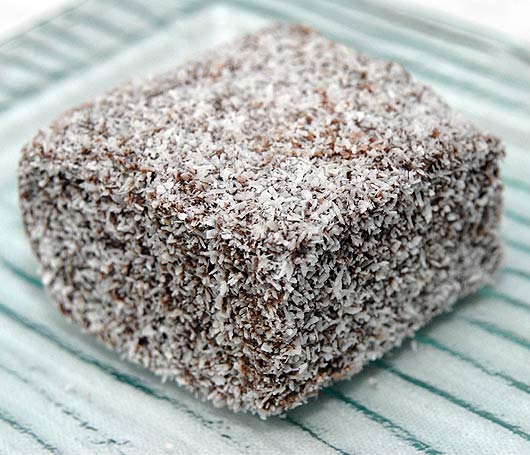
Ladies and gentlemen as I’m sure you are all aware today, the 21st of July, is National Lamington Day. It is a day to celebrate this iconic Australian delicacy so glorious in its flavour, especially with its layer of strawberry jam in the centre and an optional dollop of whipped cream on top, that it rivals the French truffle as the number one desert choice for backpackers and the dollar conscious alike. So popular is our national cake that thousands of schools from Wilsons Promontory Presbyterian Ladies College in Victoria to Steep Point Primary in Western Australia and the Cape York Catholic Grammar have used it to raise funds for the local community. Without the lamington our ‘Stop, Revive, Survive’ campaign would have become ‘Stop, have a Kit Kat and for Heaven’s sake don’t use the portaloo’.

But where did the Lamington come from?

The roots of this spongy delight dates back to Scotland where William Baillie, the Laird of Lamington, waged war on Clan Olgilvy at the Battle of Brechin in 1452. Fresh food would not last long out on the windy moors so the enterprising Scots invented a rock hard loaf of bread that was dipped in tar and coated in sand for extra roughage. Unfortunately they were soundly beaten by the Earl of Angus, who had excellent supply routes to the tastiest beef this side of Wagyu Farms, and the leftover lamingtons were used to shore up the broken walls of his castle.

It wasn’t until the 1700’s that the humble lamington was to make another brief appearance on the menu. The owners of Sporran Street Bakery, descendants of William Baille, inherited the old family recipe and began tinkering with the ingredients. Eventually a marvelous concoction of sponge, haggis and chocolate was launched upon an unsuspecting United Kingdom. The result was the Jacobite Uprisings, which culminated in the Battle of Culloden in 1745.

While the Duke of Cumberland was busy sweeping all before him the Earl of Airlie was rumoured to have stolen the lamington formula and escaped to France. Several years later he boarded the Lady Penrhyn and came to Australia, where he found a secluded beach in what would later be know as Queensland, named it after himself, and became a recluse. The humble lamington was once more lost to the world.

Then, in 1880, a strange thing happened. Students from the Mosman MasterChef College were on a field trip to Airlie Beach when one of them stumbled upon the bleached bones of long dead Frenchman still wearing his tattered Lacoste polo with a faded crocodile on the breast pocket. Lodged between the gritted teeth of a crazed and sun-scorched skull was a leather parchment covered in a Gaulish scrawl. The precious paper was prised from the jawbone and brought back to the Home Economics department; and the Iced Vo Vo was born.

So successful was the latest interpretation of the ancient recipe that Arnotts acquired the rights to mass produce the biscuit and provide it to an international audience, which is where it was discovered by Charles Wallace Alexander Napier Cochrane-Baillie (descendant of William Baillie), also know as Lord Lamington the Governor of Queensland.

The combination of desiccated coconut and pink fondant stirred up sub-primal salivations for the Lord and his Lady. Ancient emotions had awoken causing intense and confusing feelings, which frightened the couple. In an attempt to beat the addiction they retreated with their entourage to Harlaxton House in Toowoomba. There they managed to resist the cravings for several weeks but eventually the over powering desire for dried slivers of Cocos nucifera became so overwhelming that the Governor and his wife began hallucinating.

Fortunately, before the couple were able to move to Kingaroy and establish a peanut farm, the house cook came to his senses and decided to try his hand at creating his own version of the tantalizing biscuit. The only ingredients he had available was day-old sponge cake, strawberry jam, cooking chocolate and a single large coconut, so with one eye closed and his fingers crossed, he began to put it all together. The guests were enthralled by the new treat, dubbed dandruff balls by the psoriasis-suffering chef, and began consuming them in vast quantities. Finally sanity prevailed and Lord Lamington decided to share his title with the delicious cake.

The rest is history.

Since its inception in Australia that magical day in 1886 our lamington has gone on to inspire greatness within our people. In 1915 the Labour Government declared 20,590 hectares of old growth rain forest to be the Lamington National Park after our beloved desert. Later that same year the 1,700m mountain in the Oro Province of New Guinea was also named for the squishy cake. Unfortunately the same mountain erupted in 1951 killing over 3,000 people but that’s another story.

Nowadays the lamington can be found in tuck shops, supermarkets and at ex-pat barbeques all over the world. So lets raise a mug of Bushells to the sky and shout hip hip hooray for National Lamington Day.

Perhaps next year we will make it a public holiday.

Serious Note: The Variety Club, in partnership with Top Taste, has used National Lamington Day in the past as a means to raise funds for The Children’s Charity. From what I understand they have been very successful in their endeavours.


Share on Facebook Share

Hooligans, Hotties and Clairvoyant Cephalopods

The 2010 Soccer World Cup came to an end on Sunday night and I must say I have mixed feelings about the series. Let me state for the record that soccer is not my cup of tea. I like to see a result in my sporting contests and quite frankly, I find the concept of watching two hours of too-ing and fro-ing for a nil all draw rather boring. It is no wonder that there are riots. Sitting in the stands all day, drinking warm beer and leaving drunk and frustrated is bound to result in a case of ‘The English Disease’. Its not just the yobbos from the UK who wield the wooden cosh. Over the years there have been fighting in Argentina (Cordoba – 2002 World Cup), Italy (Rome – 2004, Turin – 2007), Belgium (Brussels – 1985), Ireland (Dublin – 1995), Switzerland (The Disgrace of Basel – 2006), France (Bordeaux – 2008), Russia (Moscow – 2002 World Cup), Germany (Dortmund – 2006) and many, many more. Even Australia has had issues although not as violent as those stated above.

Hooliganism.

Hooliganism goes way beyond spontaneous riots. Clashes between rival gangs, or ‘Firms’ as they are known, are often organised to take place at pre-arranged locations. Wikipedia has a list of Hooligan Firms from around the world http://en.wikipedia.org/wiki/List_of_hooligan_firms some of whom have featured in literature and movies about organised soccer violence such as Ultrà in 1990 and The Football Factory in 2004.

There is plenty of debate as to what makes a soccer hooligan. Certainly alcohol plays a part but it is not always the main contributor. Racism has been blamed by many sections of the media whilst others have suggested that confrontational policing has fueled the fires – see the Football Industry Group fact sheet published by the University of Liverpool.

Some have also proposed that the “game of football has been associated with violence since its beginnings in 13th century England.”- Social Issues Research Centre UK. But does that make it right, or even acceptable?  I’m not claiming to have the answers but perhaps a simple widening of the goal mouth to allow some points to be scored might help. A little less theatrics by some of the players might improve the spectacle as well (hands up all those who think Tim Cahill looks like a twat when he spars against the corner flag after scoring a goal?).

Thankfully this type of antisocial behaviour is on the decrease (fan related violence that is, not the ham acting) and in spite of my obvious prejudices toward the game I do have some memorable soccer moments.

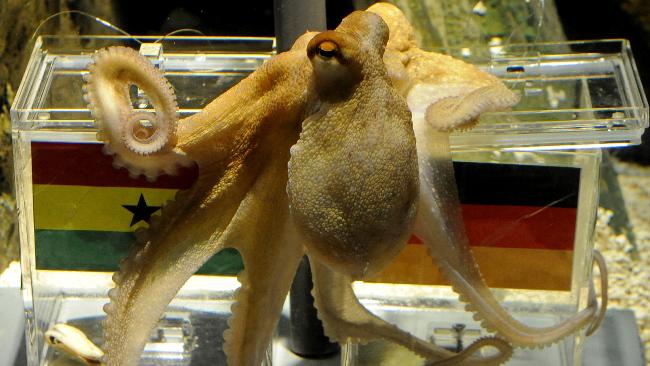
Paul the Psychic Octopus Picks The Next Winner

My top four would be:

1.) When my son kicked his first goal in the Pagewood FC Under 10s. Steve Martin’s performance in Parenthood had nothing on my sideline antics that morning. They went on to win the grand final that year and I got to run the lines.

2.) The afternoon I spent with my brother-in-law in a noisy Berlin pub as the local team lost narrowly to the visitors. Although there was not much English spoken the atmosphere was warm, the locals friendly and the beer was fragrant and flat – with a somewhat serious kick 😉

3.) I was there at Telstra Stadium in 2007 when David Beckham bent one in from the corner to score his only goal in Australia. More than 80,000 people witnessed that moment and watched as Sydney FC went on to beat LA Galaxy 5 – 3.

4.) Australia’s performance at the 2006 World Cup where we showed the world that we can do more that supply talent to the European sides.

The 2010 Highlight Reel

For me the 2010 competition highlight reel offered a lot of excitement and intrigue accompanied by the deafening hum of vuvuzelas and an octopus with the foresight of Nostradamus.

I say ‘highlight reel’ because with Australia beginning our campaign on the back of a 4 nil drubbing by the Germans (with some questionable refereeing I must add), well my resolve to get up at 4:30 in the morning was somewhat diminished (Don’t give me that look. I have a family and small children don’t care if daddy was up all night watching television.)

I loved the pinball style effort from Denmark when they scored the first ‘own goal’ of the tournament and I’m sure that when Maicon slotted that beauty against North Korea from such an obtuse and impossible angle the streets of Rio erupted into an impromptu CarnivalĂ©.

Diving is still a big factor in the game. The Italians did it to the New Zealanders in a display reminiscent of Fabio Grosso’s famous penalty against Australia in 2006. In both instances the southern hemisphere sides were robbed of victories. In my opinion this is blatant cheating and its about time that FIFA implemented a video review system.

Penalties played a major factor for many sides. Asamoah Gyan hit the crossbar in extra time, which resulted in Uruguay wining the eventual shoot out 4 -2. However, the most devastating penalty was the one that put Paraguay out of contention and Larrisa Riquelme, the model with the remarkable mobile phone pouch who promised to run naked through the streets if Paraguay won, was let off the hook.

Larissa Riquelme

But it was Iniesta’s solitary Spanish goal in the 116th minute of the final that was the most climactic. It was not a particularly fancy strike of the ball but the lead up was superb. The Dutch had defended well all day and showed no signs of cracking despite Spain having some eighteen shots at goal. Frustration must have taken its toll though as their play became more niggling and spiteful which drew nine yellow cards and an eventual send off for John Heitinga midway through the extra period. As Spain held the trophy high Nelson Mandela appeared on the field, putting a familiar face to South Africa’s national pride as Shakira ‘Waka Waka-ed’ her backside along with hundreds of other performers at the closing ceremony.

Unfortunately the Socceroos average of one win, one loss and one draw was not good enough to qualify but I was very impressed by the kiwis three draws for their first ever visit to soccer’s world stage.  The All Whites have gone from unknowns to heroes with an undefeated World Cup campaign. I for one would love to see a regular match between the All Whites and the Socceroos played yearly in a style akin to the Bledisloe Cup. Surely this would boost the competitiveness of both sides leading into 2014.

One final comment, I hope you all will spare a thought for the 74 people killed by terrorists in Uganda as they watched the World Cup final. This is a despicable, cowardly act perpetrated by the lowest form of humanity.

Viva España!

Share on Facebook Share