Gen Y – an iDad Perspective

What is Generation Y?

The simple definition of the generations is as follows:

1901 – 1924: The Greatest Generation aka The Veterans.

These guys were born during the Great War, grew up through the Great Depression and fought in World War 2. They were fed on food stamps, handouts and the grapes of wrath. If you want to argue their right to call themselves the Greatest Generation then go for it. Unfortunately you are likely to be clobbered by a walking frame, prosthetic limb or Stephen Spielberg šŸ˜‰

1925 – 1945: The Silent Generation.

These poor buggers grew up in the shadow of the Greatest Generation. They were the children who were supposed to be seen and not heard, and when they tried to speak up they copped an earful of:

MP: In them days we was glad to have the price of a cup o’ tea.
GC: A cup o’ cold tea.
EI: Without milk or sugar.
TJ: Or tea.
MP: In a cracked cup, an’ all.
EI: Oh, we never had a cup. We used to have to drink out of a rolled up newspaper.
GC: The best we could manage was to suck on a piece of damp cloth.
TJ: But you know, we were happy in those days, though we were poor.
MP: Because we were poor. My old Dad used to say to me, “Money doesn’t buy you happiness, son”.
EI: Aye, ‘e was right.
MP: Aye, ‘e was.
EI: I was happier then and I had nothin’. We used to live in this tiny old house with great big holes in the roof.
GC: House! You were lucky to live in a house! We used to live in one room, all twenty-six of us, no furniture, ‘alf the floor was missing, and we were all ‘uddled together in one corner for fear of falling.
TJ: Eh, you were lucky to have a room! We used to have to live in t’ corridor!
MP: Oh, we used to dream of livin’ in a corridor! Would ha’ been a palace to us. We used to live in an old water tank on a rubbish tip. We got woke up every morning by having a load of rotting fish dumped all over us! House? Huh.
EI: Well, when I say ‘house’ it was only a hole in the ground covered by a sheet of tarpaulin. But it was a house to us.
GC: We were evicted from our ‘ole in the ground; we ‘ad to go and live in a lake.
TJ: You were lucky to have a lake! There were a hundred and fifty of us living in t’ shoebox in t’ middle o’ road.
MP: Cardboard box?
TJ: Aye.
MP: You were lucky. We lived for three months in a paper bag in a septic tank. We used to have to get up at six in the morning, clean the paper bag, eat a crust of stale bread, go to work down t’ mill, fourteen hours a day, week-in week-out, for sixpence a week, and when we got home our Dad would thrash us to sleep wi’ his belt.
GC: Luxury! We used to have to get out of the lake at six o’clock in the morning, clean the lake, eat a handful of ‘ot gravel, work twenty hour day at mill for tuppence a month, come home, and Dad would thrash us to sleep with a broken bottle, if we were lucky!
TJ: Well, of course, we had it tough! We used to ‘ave to get up out of shoebox at twelve o’clock at night and lick road clean wit’ tongue. We had two bits of cold gravel, worked twenty-four hours a day at mill for sixpence every four years, and when we got home our Dad would slice us in two wit’ bread knife.
EI: Right! I had to get up in the morning at ten o’clock at night half an hour before I went to bed; drink a cup of sulphuric acid; work twenty-nine hours a day down mill and pay mill owner for permission to come to work; and when we got home, our Dad and our mother would kill us and dance about on our graves singing Hallelujah.
MP: And you try and tell the young people of today that ….. they won’t believe you.
ALL: They won’t!

Gotta love Monty Python šŸ™‚

1946 – 1964: The Baby Boomers.

So called because all the hippy free love and LSD of the sixties promoted a massive population explosion. They are responsible for bell-bottom trousers, love beads, chunky plastic jewellery and other fashion faux pas so gaudy that even St Vincent de Paul won’t accept their donations. Many of these people are still coming down from their high and are busily making sure they don’t leave behind any inheritance.

There are over 5,000,000 Baby Boomers in Australia alone and their motto is:

We believe that fun doesn’t have to be the privilege of the XĀ or Y Generation, and that Baby Boomers (BBs) have the right to feel as young as they like for as long as they like.

Be nice to the X and Y Generations BB, for we will be funding your nursing homes šŸ˜‰

1965 – 1982: Generation X.

Charged with repairing the damage done by the baby boomers’ excessive / compulsive nature and high-level consumption of the world resources, Generation X missed out on the Beatles, Vietnam and the good music of the Rolling Stones. Your average Gen-Xer is early forties, raising a family, worried about the cost of electricity and fed up with petrol prices. On top of that Generation Y is nipping at our heals with their tweets, Facebook likes, visible butt crack and abbreviated text language.

We were the first generation to grow up with computers and as such we are technically adept. We came of age in an era of dual income households and we often known as ‘latchkey kids’. Divorce rates were high amongst our parents and as a result we became self reliant and skeptical of authority. We grew up with grunge music and MTV (back when it was cool) and, unfortunately, we live to work rather than work to live.

1983 – 2000: Generation Y.
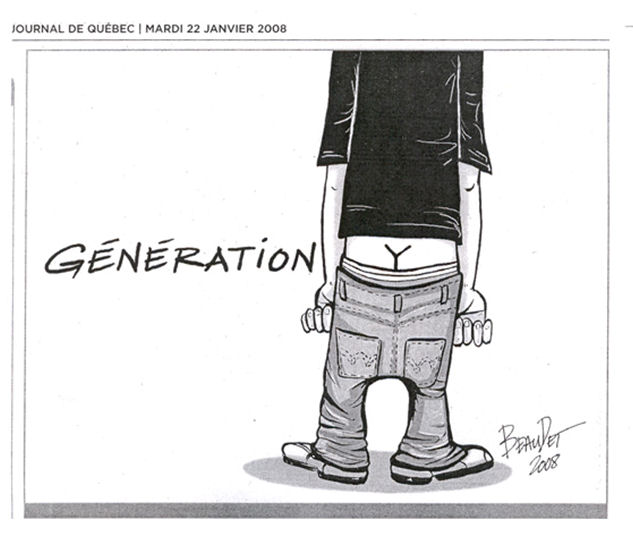
Y should I get a job?

Y should I leave home and find my own place?

Y should I get a car when I can borrow yours?

Y should I clean my room?

Y should I wash and iron my own clothes?

Y should I buy any food?

Nuff said šŸ˜‰


R U OK?

Today is R U OK? Day.

It’s a national day of action which aims to prevent suicide by encouraging Australians to connect with someone they care about and help stop little problems turning into big ones.

ā€œIn the time it takes to have your coffee, you can start a conversation that could change a life. On R U OK? Day, who will you ask?” – R U OK? Day founder, Mr. Gavin Larkin.

According to the website:

“Depression is one of the most common mental illnesses experienced by Australians and research tells us that one in five Australians will experience depression in their lifetime. Moreover, 4 per cent of us will experience a major depressive illness in a 12-month period. Clinical depression is nothing to be ashamed of and it is always worthwhile to ask for help if you think you might have clinical depression.”

The Black Dog Institute concurs that depression is a common illness, and according to beyondblue, around one in six Australian men will suffer from depression at any given time. Probably one of the most disturbing points raised on the beyondblue website is:

“The experience of male depression is complicated by the fact that men are more likely than women to shy away from medical treatment of any kind. Instead of discussing psychological problems, or seeking appropriate treatment, men may turn to alcohol or drugs when they are depressed or anxious.”

Has this always been the case? I don’t know, I’m no expert. I am however the father of three teenage boys and I can tell you that getting them to talk is akin to extracting teeth.

So where has this disconnect come from?

From my perspective male gender roles have a lot to answer for. The saying ‘big boys don’t cry’ was very common when I was a child, often delivered by older generations to stop the squawking of a bleeding boy desperate for a band-aid.

These men went to war, watched their friends die, endured the Great Depression and became the archetypal patriarch of the family. They were expected to earn the living, make the decisions, provide for the brood. All the while burying their feelings deep down inside. Men weren’t allowed to shed tears, feel emotions, or express themselves.

We went to the pub, drank beer and watched sport with our friends, never once opening up to each other.

And who decided that this was how it was supposed to be? Men, probably. Then we passed it down from generation to generation.

This is all supposition of course. I haven’t done any research. I don’t have all the answers. I’m just a man šŸ˜‰

I do tell my dad that I love him every time I see him.

I do hug and kiss my boys whenever they leave.

And I try to talk to people when the going gets a little tough.

So, on R U OK? Day do yourself a favour. Talk to your friends, your family and connect with those you care about.

Are You Ok? — Matt

R U OK? – the organisation

R U OK? is an independent, not-for-profit organisation whose purpose is to provide national focus and leadership on suicide prevention by empowering Australians to have open and honest conversations and stay connected with people in their lives.More than 2,100 Australians suicide each year and men are around four times more likely to die by suicide than females. For each person that dies in this way, another 30 attempt to end their life (Lifeline).R U OK? aims to inspire all Australians to help reduce our suicide rate by reaching out and making contact with others.Most people don’t openly share their feelings, particularly when they’re struggling so don’t wait for a sign and trust your instincts. A conversation could change a life.The best thing we can all do is regularly ask the people we care about: “Are you OK?” regardless of whether they are at risk because connection is good for us all.

Give iDad an iPad for Fathers Day

Last December I contacted Molly, my friend from the Net, who has a very interesting craft blog called Charlotte’s Fancy. Molly had designed a greeting card for Fathers Day called the iDad. With her kind permission, and Fathers day just around the corner, I have reproduced the steps to create the iDad greeting card below and provided a link to Charlotte’s Fancy for those of you with more talented hands than I.

This slideshow requires JavaScript.

To create the card you will need the following supplies:

  • Black cardstock
  • White Cardstock
  • X-acto knife
  • Cutting mat
  • Spray Glue
  • Markers

Step 1: Take two pieces of 8.5 x 11″ black cardstock, and sandwich a piece of white cardstock in between, then cut rounded corners. You may want to take out the white piece and cut it down a little further, so that it doesn’t show along the edges. Use spray glue to secure the white cardstock to the bottom piece of black cardstock and set aside.

Step 2: Find some iPad/iPhone icon images online and print them out on cardstock (you will have no trouble finding these on Google). In a Google image search, look for medium or large images, so that the resolution is decent. Once you print them out, cut them out.

Step 3: Arrange the images on your top piece of black cardstock, then glue them down in the order you want them with spray glue. Let dry for a couple of minutes.

Step 4: Using a cutting mat and X-acto knife, carefully cut along the sides and the bottom of each icon to create lift up flaps.

Step 5: It’s time to glue the top piece to the bottom piece. Spray glue very carefully on the back of the top piece, being careful to avoid the areas where the lift up flaps are (you don’t want to get glue in the area where you will be writing your messages).

Step 6: Once you glue the top and bottom pieces together, draw the little button at the bottom (I used a silver Sharpie), and trim the edges to make the whole presentation neat. Then you can write whatever messages you like under the flaps.

Finally, I printed ā€œiDadā€ onto a piece of paper, cut it out with an X-acto knife and glued it to the front of the presentation envelope.

Interesting Trivia?!

When you’re finished reading, check out the new trivial posts: More Interesting Trivia and Even More Interesting Trivia.

Mum sent me this so it has to be true – right?

Here are some ‘facts’ about the 1500s:

They used to use urine to tan animal skins, so families used to all pee in a pot & then once a day it was taken & sold to the tannery…….if you had to do this to survive you were “Piss Poor”

But worse than that were theĀ really poor folk who couldn’t even afford to buy a pot, they “didn’t have a pot to piss in” and were the lowest of the low.

Most people got married inĀ JuneĀ because they took their yearly bath in May, and they still smelled pretty good byJune. However, since they were starting to smell . .. . brides carried a bouquet of flowers to hide theĀ body odor. Hence the custom today of carrying a bouquet when getting married.

Baths consisted of a big tub filled with hot water. The man of the house had the privilege of the nice clean water, then all the other sons and men, then the women and finally the children. Last of all theĀ babies. By then the water was so dirty you could actually lose someone in it. Hence the saying, “Don’t throw the baby out with the Bath water!”

Houses had thatched roofs-thick straw-piled high, with no wood underneath. It was the only place for animals to get warm, so all the cats and other small animals (mice, bugs) lived in the roof. When it rained it became slippery and sometimes the animals would slip and fall off the roof. Hence the saying “It’s raining cats and dogs.”

There was nothing to stop things from falling into the house. This posed a real problem in the bedroom where bugs and other droppings could mess up your nice clean bed. Hence, a bed with big posts and a sheet hung over the top afforded some protection. That’s how canopy beds came into existence.

The floor was dirt. Only the wealthy had something other than dirt. Hence the saying, “Dirt poor.” The wealthy had slate floors that would get slippery in the winter when wet, so they spread thresh (straw) on floor to help keep their footing. As the winter wore on, they added more thresh until, when you opened the door, it would all start slipping outside. A piece of wood was placed in the entrance-way. Hence: a thresh hold.

(Getting quite an education, aren’t you?)

In those old days, they cooked in the kitchen with a big kettle that always hung over the fire.. Every day they lit the fire and added things to the pot. They ate mostly vegetables and did not get much meat. They would eat the stew for dinner, leaving leftovers in the pot to get cold overnight and then start over the next day. Sometimes stew had food in it that had been there for quite a while. Hence the rhyme: Peas porridge hot, peas porridge cold, peas porridge in the pot nine days old.

Sometimes they could obtain pork, which made them feel quite special. When visitors came over, they would hang up their bacon to show off. It was a sign of wealth that a man could, “bring home the bacon.” They would cut off a little to share with guests and would all sit around and chew the fat.

Those with money had plates made of pewter. Food with high acid content caused some of the lead to leach onto the food, causingĀ lead poisoningĀ death. This happened most often with tomatoes, so for the next 400 years or so, tomatoes were considered poisonous.

Bread was divided according to status. Workers got the burnt bottom of the loaf, the family got the middle, and guests got the top, or the upper crust.

Lead cups were used to drink ale or whiskey. The combination would sometimes knock the imbibers out for a couple of days. Someone walking along the road would take them for dead and prepare them for burial. They were laid out on the kitchen table for a couple of days and the family would gather around and eat and drink and wait and see if they would wake up. Hence the custom of holding a wake.

EnglandĀ is old and small and the local folks started running out of places to bury people. So they would dig up coffins and would take the bones to a bone-house, and reuse the grave. When reopening these coffins, 1 out of 25 coffins were found to have scratch marks on the inside and they realized they had been burying people alive. So they would tie a string on the wrist of the corpse, lead it through the coffin and up through the ground and tie it to a bell. Someone would have to sit out in the graveyard all night (the graveyard shift..) to listen for the bell; thus, someone could be, saved by the bell or was considered a dead ringer…

And that’s the truth!

Of course it is. My mum said so!

Don’t forget to check out the new trivial posts:Ā More Interesting TriviaĀ andĀ Even More Interesting Trivia.