
Close Call

angelI was in my local cafe yesterday morning, quaffing a quick cuppa and watching the antics of the extended family occupying the al fresco area. Grandpa was having a ball as the dynamic duo of Lilliputian princesses climbed all over him. Grandma had a very young one all snuggled up in her lap, and mummy was gently rocking the perambulator back and forth in a vain attempt at coaxing the tiniest one of all back to sleep. It was a privilege to observe such a happy family unit, but as I paid for my cappuccino all hell broke loose.

The first thing I heard was mummy’s scream. It was loud, plaintive and came straight for the deepest part of her soul. No horror movie has ever captured such a sound of wretched terror and the only noise to compete with it was the elderly banshee with the baby in her lap. My head swivelled sideways faster than a barn owl just in time to see a yellow angel, with pink ribbons adorning curly brown pigtails, race across the road after her Grandfather, who had taken her older sister to the park on the other side.

For a moment it appeared that time had actually stopped and was trying to reboot in a slow, deliberate process.

A tiny frightened girl stopped in the middle of the street and burst into tears, unsure whether to turn back or keep going, and afraid that she was going to get into enormous trouble.

A seated Grandmother threw her arms out, desperately hoping that her reach would magically extend to ensnare her grandchild.

A mother’s shoes refused to grip the ground as she tried to leap the many metres that separated her from her child.

And, with three mighty steps, a Grandfather found the strength of youth when he bounded into the road and scooped up the crying little one.
MinionThankfully the bus service was running late and no other traffic was on the road at the time, so everything ended fine with the siblings happily heading off to the playground.

The whole experience occurred in mere moments, but as the adrenalin began to wear off it caused me to reflect on a similar circumstance that happened many years before. Our third son Granny, who was always pushing the boundaries of acceptable behaviour and is single-handedly responsible for the majority of my grey hairs 🙂 decided one day that it would be fun to run out on the road and see how far he could get before mum or dad caught him. The street he chose though was not as quiet as the one yesterday and I can still see the look of panic on the occupant’s faces as their cars swerved to miss him.

Granny is fine of course, and has just graduated from high school. But I learned that day that the price of parenthood includes vigilance. Kids are predictably unpredictable and that can place them in all sorts of predicaments – both good and bad.

So, as thousands of our little monsters hit the streets hunting for Halloween treats, please do iDad a favour and hold onto their hands.

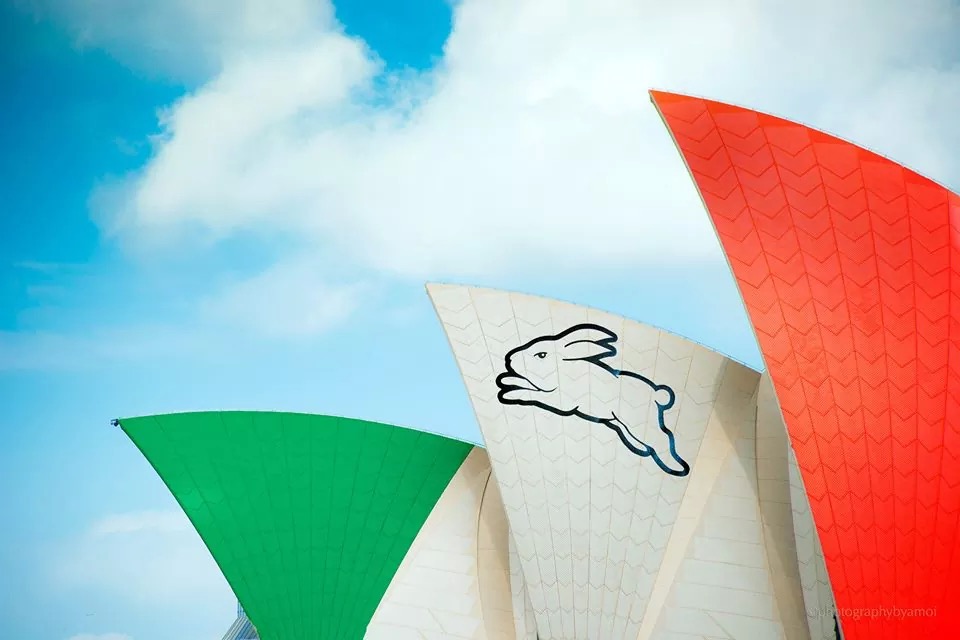
The Rabbitohs Grand Final is one for the artists and dreamers

An article originally published in The Conversation by Ms. Liz Giuffre, Lecturer of Media, Music and Cultural Studies at Macquarie University, and someone I always respected.

IMG_1380This coming weekend’s Rugby League Grand Final has already made history. The South Sydney Rabbitohs, a team that were on the chopping block just over a decade ago, are now in the big game – against the Canterbury Bulldogs – after 43 years of waiting. Their story has gained attention well beyond a little pocket of Sydney suburbia, with good reason.

The drama of the little team that could has been riveting – and it’s attracted actors, theatre-makers, and comedians keen to tell the story again and again.

Rugby League isn’t a game that obviously and overtly draws artistic types; but the South Sydney Rabbitohs are a different type of team. They are an inner city/south east Sydney team that attracts battlers and underdogs. And the team has been close to the brink many times.

In the late 1990s the Murdochs proposed a Super League competition and Souths, who were lingering at the bottom of the ladder, faced extinction. The fan community rallied and the team has survived – but the showdown with News Limited hasn’t been forgotten.

IMG_1401This week Fairfax newspapers revived the saga, arguing, “whenever you see a Murdoch newspaper claim ‘we’re for Souths’, remember the treachery and call it hypocrisy”.

The battle to save Souths wasn’t just about community versus corporations, but in this case, the media corporation, News Limited, and its desire to take the game to Pay TV. This was a “little Aussie battler” arguing over identity and types of belonging that were much bigger than simply a code.

In 1999, when the future of the team was in strife, tens of thousands of Sydneysiders took to the streets to try to turn the tide. As Rabbitohs fan Andrew Denton put it on the ABC’s Australian Story in 1999, it was a display of:

IMG_1394an Australian community and team trying to keep its identity in the face of the corporate dollar and an attempt to squeeze a few more bucks out of Pay TV.

In Denton’s words from that time: “You don’t have to follow football or understand the game to follow [the] story. It’s that old classic David and Goliath”.

By 2001 the team’s fate looked stronger and Australian Story returned again to the Bunnies. Comedian and Rabbitohs supporter Mikey Robbins called the Souths:

more than a story about a football team, it’s about a small community that took on a multinational, multimedia organisation.

The Rabbitohs on stage

IMG_1403In 2004 the story of the Rabbitohs vs News Limited was developed for the stage by writer Alana Valentine and Kate Gaul and supported by Sydney’s Belvoir Street Theatre as Run Rabbit Run. The production broke stereotypes about rubgy league: the show was driven by women, “arty” types and Indigenous communities – not a club of beer-swigging boofy white blokes.

A key feature was the letters of support (and advice for the Murdochs) from people like the broadcaster Caroline Jones. Her letter, as reproduced in the teacher’s notes for the play, addressed Murdoch junior:

Dear Lachlan, it might help if I explain a few things about Australians 
 They say we’re still not sure what our identity is, but try taking it away from us and you’ll soon find out because suddenly it becomes very clear what it is to be unAustralian.

IMG_1413Delivered during the Howard years, when being called unAustralian was the ultimate insult, these were fighting words. It was as if an attack on the identity of a local, historical, social group such as South Sydney was an attack not just on football but on the nation.

Run Rabbit Run covered the drama of the game on its own terms and also dealt with the politics within the Rabbitohs’ traditional fan base, one that encompasses a spectrum of fans including working class, Indigenous and disadvantaged communities, as well as inner city and international superstar types.

From Saint George to Superbacker Russell

The original fight to save Souths came via the former Chairman of South Sydney Leagues Club and former player George Piggins.

He was the man who took the NRL and New Limited to court. The 2001 Australian Story was really his, titled simply “In George We Trust”.

But once the battle to stay on the field was won, the battle to build a winning team was taken over by a much bigger player, or at least one with much deeper pockets – Russell Crowe.

Crowe purchased the team with Peter Holmes à Court in 2006. He has famously bankrolled Armani suits for players, poured rivers of cash into the team’s infrastructure, and made sure his Hollywood mates know what team to support when they’re visiting.

A photo gallery of Famous Rabbitohs Fans includes Oprah Winfrey, Snoop Dogg, Ben Affleck, Eva Mendes, Christian Bale and Pamela Anderson all in bunnies gear – none even necessarily even knowing what NRL is, but at least willing to fly the flag. Crowe and Holmes à Court have made the team financially viable and the code’s biggest brand – not bad for a team thought of a dispensable not so long ago.

As for the actual game this weekend, the team is as strong as it’s been in a long time. Whether Souths win or not – although, wouldn’t it be lovely! – the story of the Rabbitohs remains unique, unlikely and inspiring.

IMG_1410

Blippar The AR Monster

Augmented reality (AR) has had a relatively slow uptake amongst magazine publishers and media agencies however publishers globally are beginning to see AR as an opportunity to innovate and even create new revenue streams, thus reinforcing the power of print. The recent takeover of AR company Layar, by image recognition platform Blippar, is poised to create a leviathan in the AR world that will generate a major push towards a broader adoption of augmented reality.

“Blippar’s takeover of Layar has
caused shockwaves in the
augmented reality market,
and rightly so – it is the most
important acquisition yet within
this sector.” – Output Magazine

Recently I had the pleasure in sharing breakfast with Ms. Kate Russell, an ex-pat Australian executive previously employed by Layar and who is now the Strategic Accounts Director for Blippar – based in their Amsterdam offices.

Tell me Kate, what did the purchase of Layar mean to you and your colleagues?

“Although both companies will continue to operate as separate entities for a while, Blippar have begun incorporating our staff and clients into their systems. By joining forces we have now effectively created the largest AR reach in the world. Together, we are the undisputed leader of Augmented Reality and visual browsing with offices in the US, UK, Europe and Asia.”

So what has the takeover meant for your clients?

“The deal represents an exciting opportunity for clients of both businesses –the combining of two of the globally leading AR platforms and all the data and best-practice that both business have accumulated. Together we have over 100,000 users of either the Blippbuilder or Layar Creator platform spread throughout around 5,000 publishers and brands that use our products. Publishing companies such as CondĂ© Nast, Hearst and Meredith have enjoyed the success of AR campaigns as have major brands such as Coca-Cola, Pepsi and Procter & Gamble.”

Output Magazine has reported that the takeover of Layar by Blippar is one of the most important acquisitions ever within the augmented reality sector. Would you agree?

“Definitely. Independent research has shown that mobile AR apps are tipped to generate $5.2 billion in revenues by 2017 and that customers are 165% more likely to buy a product that includes an AR marketing component. To be the leading provider of AR solutions at this time provides a wonderful mix of benefits for our clients and the company as a whole.”

So interactive print really offers significant advantages to publishers and advertisers?

“For sure. Our research shows that people viewing interactive print will click on the content 87% of the time. That is a major improvement on engagement over static advertising. Publishers can now measure how their readers interact with the printed version, which is of great value to them.”

That’s great news for publishers and marketers. So when do you think you’ll be moving back to Australia?

“Ha ha. Well I think the Australian market is ready to embrace interactive print so I don’t think it will be long before we have a more permanent presence here.”

We hope so too.

For more information on Blippar and Layar please follow the links to their websites and you can contact Kate on kate.russell@blippar.com

Show Me Shomi

Publishing industry takes a page out of the future with Aussie startup Shomi.

Australian-based tech startup Shomi has potentially invigorated the future of the publishing industry with the release of their new scannable font-based code. It’s similar to a QR code in its capacity for mobile linking, but Shomi’s insight and design-led thinking has innovated the entire scanning process and with it, possibly the publishing industry too.

“The purpose was to simply link
print to digital content with
the use of a font-based code,”
says founder Tony Williams.

With function and form in mind, Shomi has created an iconic nine-character font code that when uniquely generated may be copied and pasted into any material or line of text, in any colour. This succinct alternative to QR codes is a godsend to designers used to the obtuse mobile linking graphics, and grants access to a new world of interactivity potential for publishers.

Mobile Linking Technology (MLT) was developed by the Japanese automotive industry in 1994 for tracking parts. However, the codes from this system (QR codes) contain far more data than required when used in a broader application, such as multimedia links from printed media. This lack of translation has led to graphic design challenges and low uptake of the technology. Shomi have now addressed this.

“We’re excited to see how it might
be used in different contexts, like
how we could integrate traditional
teaching with interactive learning,”
says Williams.

Alongside the streamlined code, the startup has produced an easy to use, standardised scanning application. Their in-text code and compatibility with augmented reality scanners such as Google Glass means Shomi offers a new world of interactive potential for printed and digital media.

The application features include a scan history and a social media component for sharing user scans across customers’ personal networks.

Standardising the scanning tool also provides innovation for marketing departments, with a clean user interface, scan-tracking analytics, pay-per-scan options and engagement insights for better placement of advertisements.

“Because only the Shomi software
can read the Shomi code,
we capture more data and
we can offer a safe and
consistent end-user experience,”
says Williams.

Indications suggest that Shomi’s concept is solid, with kudos coming in from the tech industry. Google Australia handpicked Shomi to participate in their startup program held in Sydney in 2014. Shomi are also finalists in Anthill magazine’s 2014 SMART 100, and clients such as Deloitte Digital are giving positive feedback.

Consumer uptake of MLT is now showing solid growth despite a slow start. According to Forrest Research, smartphone users that made use of a QR or 2D barcode in a given month was measured at only 1% in 2010, but by 2011 it had jumped to 5%, and by 2012 usage was up to 8%. In 2012, digital monitors ComScore reported a 96% increase in European QR code usage for the year, and a recent Adobe survey showed around a third of those surveyed had used the technology in the past three months.

Despite other mobile linking alternatives such as image recognition technology (IRT) and optical character recognition coming to market, there appears to be a space for simplicity. End users of IRT still need to be educated that an image is scannable, and the technology can be resource intensive for smartphones.

The Shomi app is free to download and use from the website, with basic analytics offered in the freemium version. The startup is looking for seed funding and is currently running a Publishing Partners Program, with special incentives for a limited number of selected publishers.ShomiHomePage

Talk to Tony Williams for more information.

Tony Williams, Founder and CEO, shomi.me

0412 784 850

tony@shomi.me

Use Shomi for free at http://shomi.me/