Pine Gap Gets Published

Thanks to the most wonderful editor / publisher on the planet, my novel ‘Pine Gap’ is now available through Blurb and Amazon Australia, UK and worldwide. Limited edition first release paperbacks are also available for those that staunch collectors of classic literature. A big thank you to my children, my family and especially my wife, for all their encouragement and support.

Driver William James Roseland – Rest in Peace.

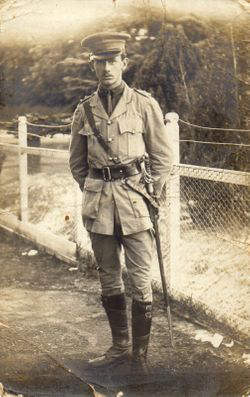
Every year, around ANZAC Day, I share a thought on social media for my Great Grandfather William James Roseland, who perished in France during the ‘Great War’. The greatest sadness for me is the photo below, a loving father with his brand new baby boy who never saw each other again.

Today, August 14 2018, is the 100th anniversary of William’s death. A milestone I nearly missed if it wasn’t for my cousin John Francis Roseland (named after my mother Frances) who compiled the majority of the information that follows.

William James Roseland, born in Brisbane c1893, enlisted on the 7th December 1916 at the ripe old age of 22 and half years old.

He was 5 feet 9 inches tall at the time of his enlistment, weighed 144 pounds with a chest measurement of 31-34 inches and had fair hair and blue eyes.
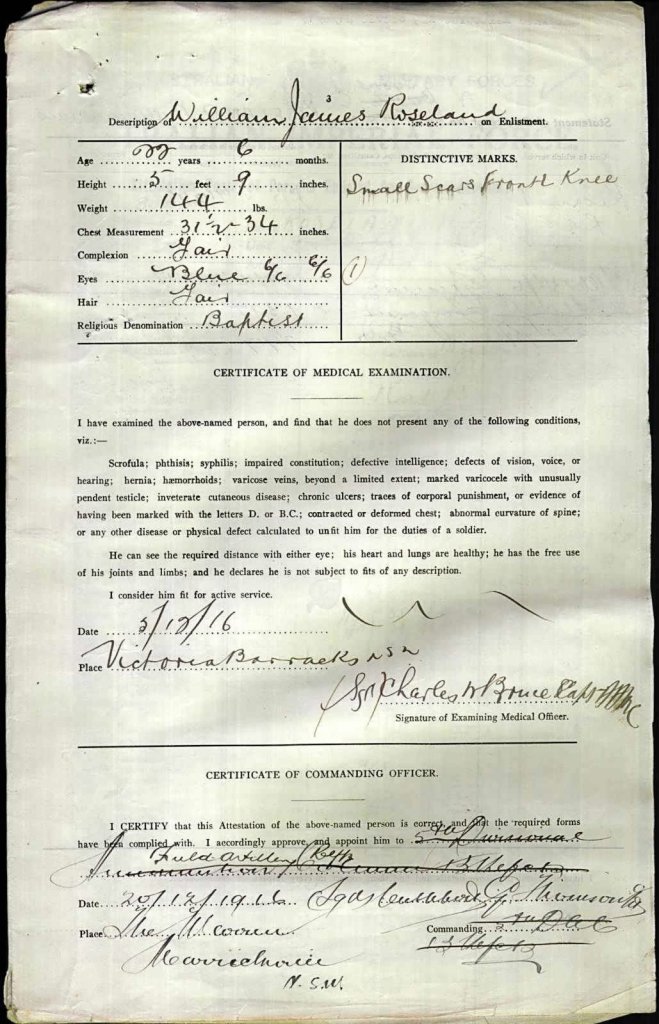
His distinctive marks include small scars on his knee. I’m not sure how identifiable this would be for a casualty in battle though, but it was noted all the same. Like so many young men of this time it is believed that he was at least 2 years younger. Meaning he was possibly 21 when he died. You can see below the attestation of his enlistment papers – no date of birth is mentioned.

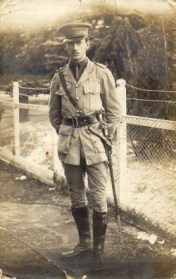
The only son of George and Margaret Roseland, William made his way to Sydney where he married Ruth Winifred Field, or ‘Nanny Field’ as we used to call her.

On April 19th 1917 he fathered his only child, a son, Ronald William Roseland – the baby in the picture at the beginning of this post – our grandfather and a man I loved dearly.

Just over a month later William embarked from Melbourne on board HMAT Suevic. He never saw his wife or son again. The boat traveled via South Africa, and with basic training along the way William soon found himself amongst the horrors of the western front.

As an engineer who had experience handling horses, William was given the rank of Driver. This meant he was in charge of a team of horses that pulled gun carriages in and out of the required locations.

A dangerous mission that left him undefended on many occasions.
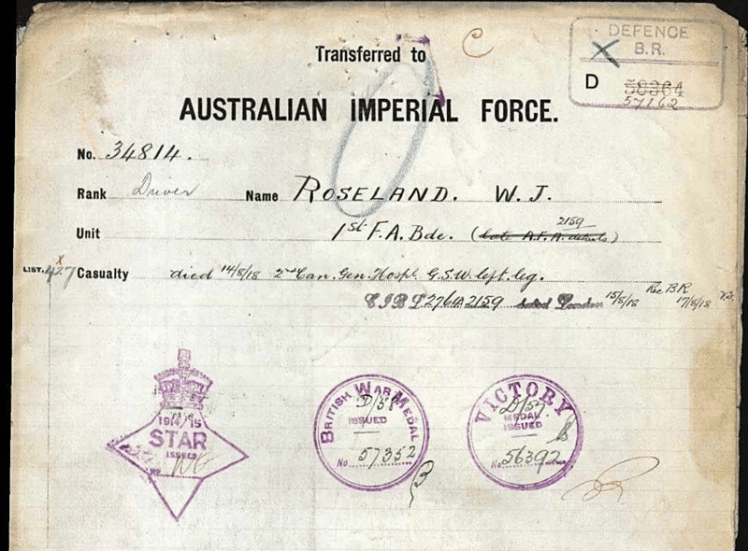
Medals Awarded

Medals Awarded

On the 10th of August 1917 Whilst undertaking one of these transports a shell exploded with in his vicinity, which caused some shrapnel to lodge in his leg. A note written by one of his brigade said” I saw Driver Roseland not long after taking the shrapnel to his leg. He was in fine spirits and was not in need of aid to walk to the triage station. “ Adrenalin is amazing, but eventually it wears off.

Unfortunately, there were no antibiotics at this time and within 2 days he was admitted to the 2nd Canadian General Hospital. Things then became critical with the leg turning gangrenous. His leg was removed however it was too late as sepsis had taken over his body. On this day 100 years ago he died in a faraway country with no family by his side.
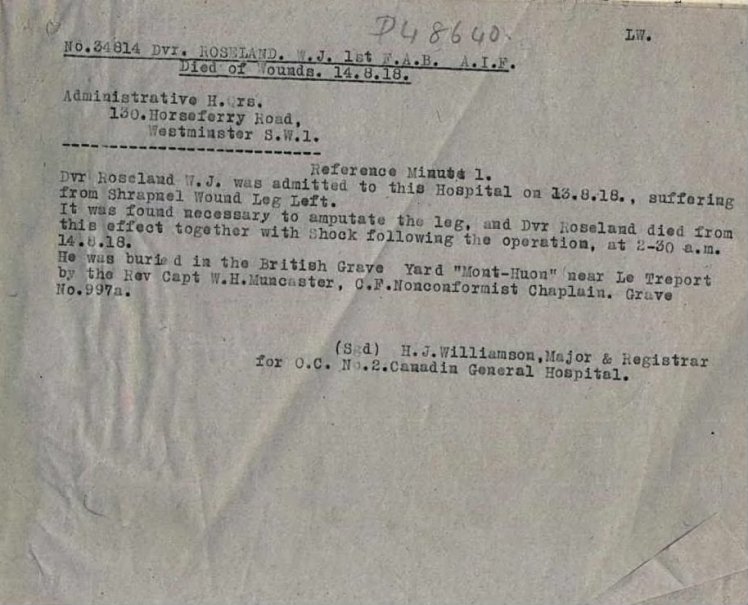
He is buried in the Mont Huon Military Cemetery (Plot VII, Row A, Grave No. 2A), Le Treport, France.

Photo taken by my cousin Steven Roseland

Photo taken by my cousin Steven Roseland

After his death my great grandmother was devastated. A young mother, with no income other than a war pension, wrote to the AIF desperately seeking her husband’s effects. Her penmanship is perfect, but the date is over nine months since William’s passing.

The reply is a sobering reminder of the futility of war.
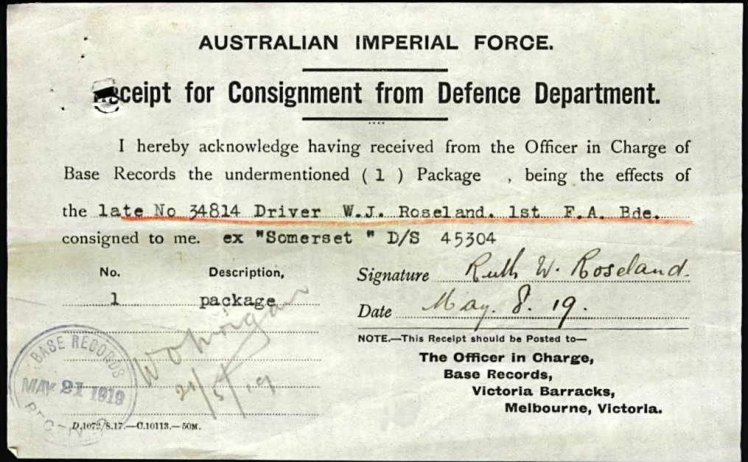
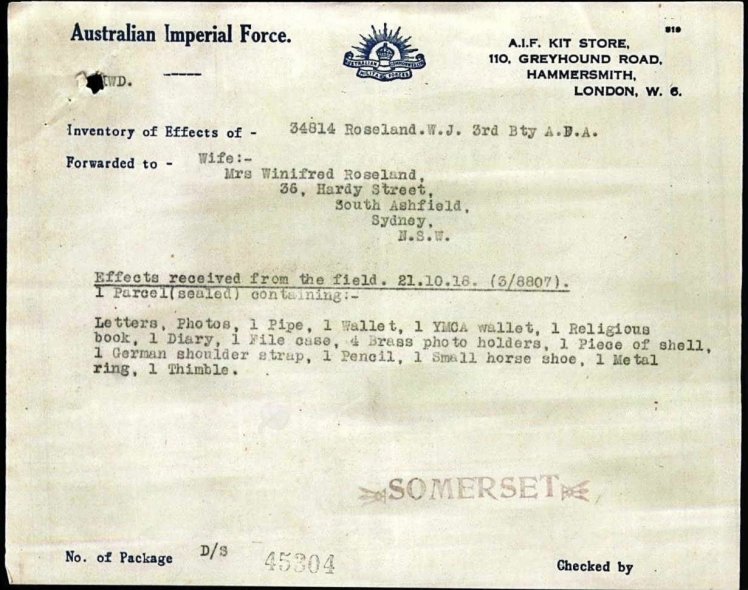
A bible, a thimble, a wedding ring…William wasn’t sending much home other than his love.
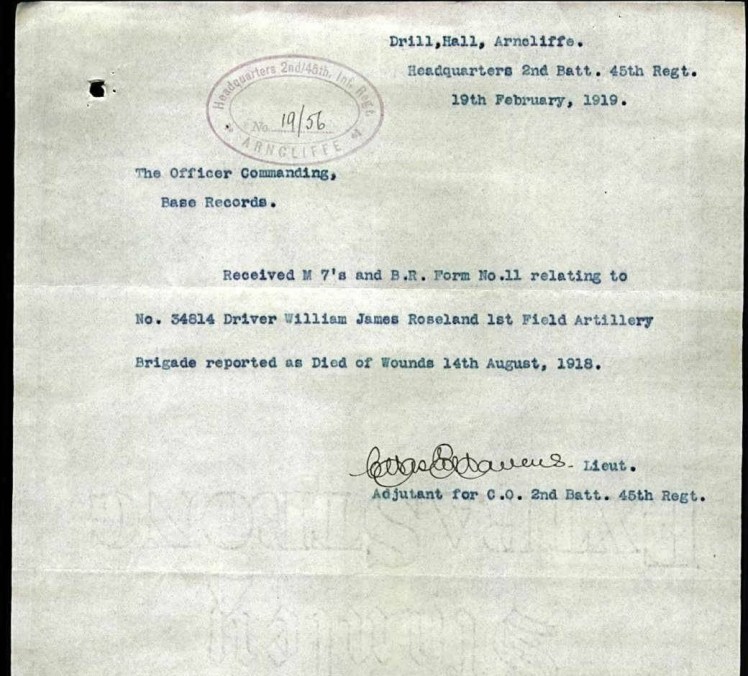
I’d like to say that I miss William James, but I never had the opportunity to meet him. I did name my youngest son Lachlan James after him, in his honour. I did have the pleasure of knowing my great grandmother’s second husband, who we affectionately called Pop. He was a lovely man who died when I was very young. He was in his nineties and I was less than ten.

War is Hell, or so the saying goes. But Alan Alda said it best in an episode of MASH when his character, Dr Hawkeye Pearce suggested that war was worse. When he was questioned by Father Mulcahy how he arrived at that conclusion he asked who went to hell. Fr Mulcahy said that Hell was for sinners. Hawkeye said that, unlike Hell, innocent people died in war. I agree with Hawkeye, war is worse.

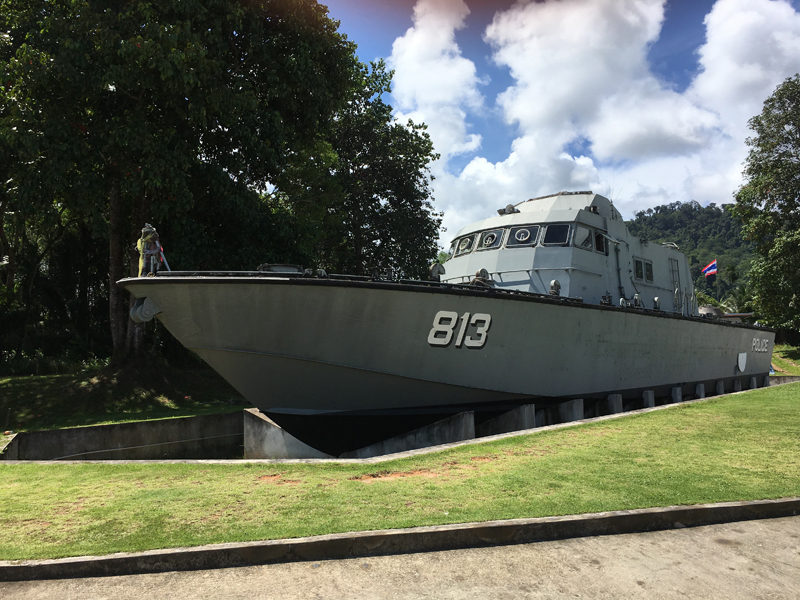
The Fate of Patrol Boat 813

Patrol Boat 813 was built in 1994 and operated under Marine Police Station 1, Division 8 Marine Police Bureau, Pak Nam Sub-District, Mueang District, Ranong Province in the Kingdom of Thailand. The primary role of Patrol Boat 813 was to protect and secure the VIPs of the country and on the morning of the 26th December 2004 Patrol Boat 813 was anchored approximately one nautical mile offshore in front of the La Flora Resort in Khao Lak whilst Thai Prince Khun Poom Jensen was jet skiing.

Several hours earlier the third largest earthquake ever recorded on a seismograph struck off the west coast of Sumatra, Indonesia. The subsequent tsunami swept the Prince from existence and washed Patrol Boat 813 almost two kilometres inland killing the entire crew. Other members of the Royal Family were lucky to escape with their lives by sheltering in the upper floors of the resort.

Today the boat stands where the tsunami placed it and is kept as a sombre memorial to the estimated 227,898 people killed by the monstrous waves.

The Saddest, Most Beautiful Cemetery in the World

This article was originally published as six separate posts on Wish You Were Here. You can read them separately by clicking this link.


Late last year Heidi and I had a short break in Turkey and managed to spend a day at Gallipoli. It was a haunting experience filled with admiration for the soldiers of both sides who stepped up into a war they had no control over yet maintained their dignity and respect for each other, and a heavy sadness for the immense loss of life. Throughout this long post we will share information from the Commonwealth War Graves Commission and our images taken on the day, in the hope that we can convey to you the emotion of standing in the saddest, most beautiful cemetery in the world.

A good army of 50,000 men and sea power – that is the end of the Turkish menace. Winston Churchill, 1915

Ari Burnu

“Within days of the outbreak of the First World War in August 1914, both Australia and New Zealand began to raise forces to support the British Empire’s war effort. The first cohort sent to Europe was redirected to Egypt for initial training, arriving as early as December 1914. They were organised into a new formation: the Australian and New Zealand Army Corps, or ANZAC. This included the 1st Australian Division and the New Zealand and Australian Division, incorporating the New Zealand Infantry Brigade, the 1st Australian Light Horse Brigade and the New Zealand Mounted Rifles. Also attached to the corps were the 7th Brigade of Indian Mounted Artillery, and the Ceylon Planters Rifle Corps. Placed under the command of General William Birdwood, the ANZAC Corps was assigned to take part in the Allied amphibious landings which would begin on 25 April 1915.” Commonwealth War Graves Commission.

Beach at Ari Burnu

Beach at Ari Burnu

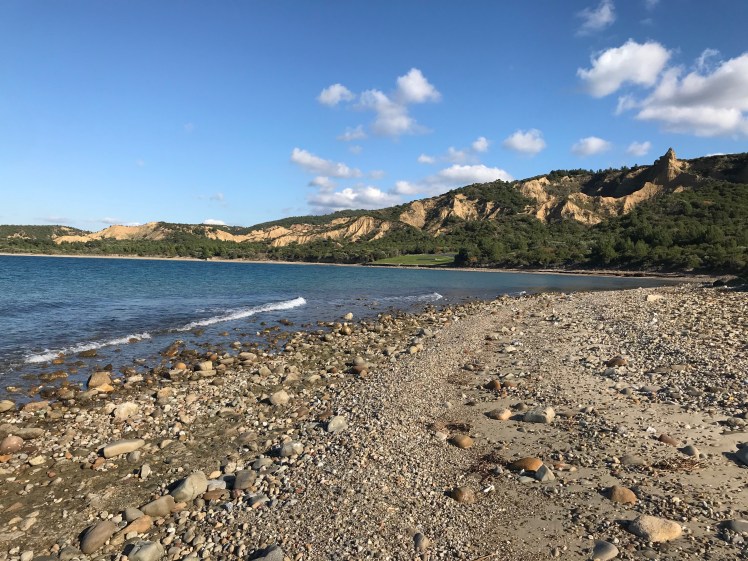
Standing on the beach at Ari Burnu where some 4,000 ANZAC troops came ashore on that first morning of the campaign was an eerie experience. In the relative silence of birdsong and lapping waves it was hard to picture the chaos of violence and death that once stained this unassuming little inlet. Our guide pointed out that in the darkness and confusion the ANZACs had come ashore at the wrong place. What should have been an easy run across flat fields was now an impossible landscape of deep gullies and high ridges.

“By nightfall over 16,000 troops were ashore, the beaches were full of wounded men, and those on the slopes were digging in. This area soon became known as ‘ANZAC’, and its features would be renamed by those living and fighting here: Shrapnel Valley, Plugges’s Plateau, Johnston’s Jolly, Happy Valley, Russell’s Top, the Nek, Walker’s Ridge, Lone Pine.” Commonwealth War Graves Commission.

The Target

Ari Burnu Cemetery was established within days of the first landing. Today there are 151 Australian soldiers, 35 New Zealand soldiers, 27 soldiers from the United Kingdom, 3 Indian soldiers and 37 unidentified bodies interred here.

The Cenotaph at Ari Burnu

ANZAC Cove

Those heroes that shed their blood
And lost their lives…
You are now lying in the soil of a friendly country.
Therefore rest in peace.
There is no difference between the Johnnies
And the Mehmets to us where they lie side by side
Here in this country of ours…
You, the mothers
Who sent their sons from faraway countries,
Wipe away your tears;
Your sons are now lying in our bosom
And are in peace.
After having lost their lives on this land
They have become our sons as well. – Mustafa Kemal Atatürk 1934.

Standing on the beach at ANZAC Cove you realise the hopelessness of the situation. Although the landscape in 1915 was devoid of trees (the majority of which had been cut down by local villagers over the years – mainly for firewood) it was still as steep and unforgiving as it is today. The lack of foliage may have facilitated troop movement for the ANZACs, but it also meant there was no cover from the Turkish resistance that was getting stronger every hour as reinforcements arrived. You can only wonder what was going through the mind of a young soldier as he clambered out of a leaky rowboat and started hurtling himself up a hill under fire from above.

Sphinx, Russell’s Top and Plugge’s Plateau in Black and White
Sphinx, Russell’s Top and Plugge’s Plateau today

“According to the article 2 of the Law on Administration of Provinces No. 5442 the Turkish Government has decided to name the coast that is located between the longitude 26 16 39 and the latitude 40 14 13 of the Gallipoli peninsula as ‘THE ANZAC COVE’ to the memory of those soldiers belonging to the Australian and New Zealand Army Corps (ANZAC) who landed here on 25 April 1915 during the campaign of Dardanelles which constitutes one of the most glorious wars on our history and whic (sic) also has an important place in world history.” Plaque laid at ANZAC Cove April 17th 1985 – Image below.

The Allied objectives in 1915 were simple. Land at Gallipoli, capture Istanbul and provide a supply route to Russia. This would have opened another front against Germany and its ally Austria-Hungary. It wasn’t to be.

“From the beach, groups of men rushed up steep, scrub-covered slopes towards the high ground. At first the few Turkish defenders were pushed back. Isolated groups of Australians and New Zealanders fought their way to where they could see the Dardanelles. As the day progressed Turkish resistance strengthened. By nightfall none of the objectives had been reached. The commanders on the spot recommended withdrawal but were ordered instead to dig in and hold on.” Gallipoli Peninsula Peace Park.

ANZAC Cove Today
ANZAC Cove Today

The beach head at ANZAC Cove was 600 metres long, but only 20 metres wide meaning that there was not much space to launch a successful military campaign. Supplies could only come in at night and they had to be carried via donkey to the front line. Casualties had to be evacuated the same way. Thousands of men lived in dugouts during the 240 day campaign coping with oppressive heat, freezing cold, swarms of flies, bully beef, artillery shells and sniper fire, at all times surrounded by the stench of death.

You have got through the difficult business, now you dig, dig, dig, until you are safe. General Sir Ian Hamilton. British commander-in-chief, Gallipoli.

As the ANZACs dug in for dear life the British landed at Cape Helles and were met by fierce Turkish resistance who kept the British pinned down on the tip of the peninsula. On the 6th May a combined assault using ANZACs, French and British troops was planned but little progress was made for the next two days. On the 8th May the ANZACs were ordered to push forward towards the village of Krithia. Unfortunately the enemy had set their own lines and over 1,000 Australians and 800 New Zealanders were killed or wounded.

Sir, this is a sheer waste of good men. Joseph Gasparich, New Zealand soldier, Krithia, 8 May 1915.

ANZAC Commemorative Site

On the 19th May the Turks mounted a counter attack. Wave after wave of Turkish soldiers slammed into the ANZAC trenches only to be met with such desperate and concentrated fire. At the conclusion of the battle 0ver 10,000 Turkish soldiers were wounded and approximately 3,000 lay dead. The ANZACs lost 160 dead and 468 wounded. Horribly, the dead Turks lay out on no mans land until the 24th May when a temporary truce was declared so that the bodies could be retrieved for burial.

The Sphinx
The Sphinx

“As the summer heat intensified, conditions on Gallipoli deteriorated. Primitive sanitation led to a plague of flies and the outbreak of disease. Thousands of men were evacuated suffering from dysentery, diarrhoea, and enteric fever…Men suffered particularly from lice in their clothing. Morale sank as the prospect of victory receded. Many came to feel they would never leave Gallipoli alive.” Gallipoli Peninsula Peace Park.

The stalemate remained for several months.

ANZAC
ANZAC

Admissions, Bah Humbug

Abacus image from the Slide Rule Museum

Article originally published in the International Admissions Bulletin – issue 4, and on the OpenApply website.

I am a Business Manager, a title that conjures up the stereotype of the bespectacled Ebenezer Scrooge, hunched over his abacus, counting the sheckles, and sardonically berating anyone who dares to suggests an expense that lies outside the approved budget. Sometimes this is true, but more often than not nowadays the miserly behaviour of old Mr Scrooge has become a relic of the Dickensian era. The new and improved version of the Business Manager has a thorough understanding of all the school systems such as HR, IT, Operations, Marketing, Finance and Admissions. We actively engage with all the different department heads and in smaller schools we perform many of these tasks ourselves. We do a bit of everything except teach, and some of us have done that as well.

The other stereotypical comment I hear a lot is that ‘anyone can do admissions’. Well I can honestly tell you that this perspective is a load of hogwash. It is a generalisation held by people who have never had to do the job, or worse, have forgotten how hard it was.

What I have learned during my thirty-something years as a senior manager is to keep an open mind and listen to people. I am not just referring to the CEO or the Board of Directors, who are obviously very important and need your undivided attention, but you need to listen to your colleagues, and in an International School setting the Admissions Officer is key.

The Admissions Officer is the face of the school, a responsibility that carries a very heavy weight. To do so effectively the Admissions Officer needs to know the intricate workings of the school. Cafeteria menus, uniforms, bus timetables and after school activities are items that frequently come up for discussion during the enrollment process. A level of understanding of the curriculum is important too when it comes to presentations and school tours. Then there is the wider school community where influential groups such as the PTA (Parent Teacher Association) need to be taken into consideration when it comes to supporting a new family.

The Admissions Officer has to have faith in the Head of School, the teaching staff and the academic quality of the education provided. Any member of the Admissions team that is not prepared to send their own children to the school speaks volumes to a prospective parent. Many schools offer free or reduced tuition fees for their Academic staff. It is my considered opinion that Admissions staff should receive the same cost benefits, otherwise it becomes very difficult to explain to prospective parents why their children are not at the school.

An Admissions Officer not only needs to be empathetic towards the concerns of the enrolling family, but must balance that empathy with courage to suggest alternative solutions if the school does not have the right facilities for their child. They will deal with happiness, sadness, confusion, anger, trepidation and delight, often all within the first meeting, which quite often requires them to be able to read between the lines. Management of such varied and diverse personalities is a difficult task that the Admissions Officer will perform with courtesy and respect.

For new families, factors such as visa restrictions, political ideals and the economic climate lie outside the sphere of influence of many schools, but local rules and regulations will have a significant impact on the enrollment process, and a good Admissions Officer will be across many of the issues that face these families. For example: many international schools in Vietnam have a cap on the amount of Vietnamese Nationals that can be enrolled. Breaching this cap can lead to fines and problems with the Ministry of Education and Training. With such a high demand for an international education it is not uncommon for families to exert whatever influence they might have in order to secure a place at the school. When this happens the propensity to begin enrolling students who are not ‘mission appropriate’ increases, which has a long-term negative impact upon the wider school community.

In Oman the Ministry of Education has strict guidelines on the content of Arabic that must be taught in their schools. It is also mandatory for Omani students to be taught Arabic as a first language, regardless of whether it is spoken at home. My school is an International Baccalaureate PYP School catering for expatriate children and Omanis alike. We are in the process of incorporating the local Arabic curriculum with the IB, which is no easy task. The aim of our Admissions team is to maintain a ratio of 50% Omani students and 50% expatriate students. This makes timetabling easier to manage and assists in staff recruitment. Our team also try to ensure a healthy mix of boys and girls. It is a convoluted process, aided by OpenApply, but still requiring a significant amount of human interaction. This is where a good Admissions team can really shine.

Last April I attended a training course in Doha, Qatar. The theme of the course was ‘Bringing Admissions to the Leadership Table’ and I was dismayed to learn that the Admissions Officer was still not considered to be part of the Senior Leadership Team within many schools. As a Business Manager my main responsibility is to ensure the financial stability of the school. There are many stakeholders involved in this process and I have always considered the Admissions team to be an integral part of the group. Whether you work in a non-profit or a proprietary school the pressure is on to fill places and cover costs. The Admissions team provide the Finance department with up-to-date student numbers and enrollment trends. I rely on their knowledge and expertise every year when setting the budget and without this support many of the key financial decisions that I make would become much more difficult.

In my experience Admissions is a very personal task requiring compassion, courage, empathy, strength of character and a high degree of intelligence. The admissions process cannot be templated or streamlined as it requires the right person, with an appropriate skill set, in order to be done correctly. I encourage you dear reader not to ‘Bah, humbug’ Admissions. Bring them to the leadership table of your school.