Pine Gap Synopsis 2018

With my novel ‘Pine Gap’ now being published through Blurb and Amazon Australia, UK and worldwide. I thought I would share a synopsis for you so you can see what all the fuss is about.

Deep in the heart of the Australian desert an impenetrable military prison is being invaded by an insidious aggressor. Time is running out for the small defence force who are no match for rotting corpses, giant spiders, voracious sabellids and the other alien beasts that begin appearing around the facility. As the indiscriminate killings continue only the arrival of Colonel Gabriel Drax gives the fractured team any chance of survival. But will this brilliant tactician lead them to safety, or is he too late?

Pine Gap is a science fiction / action novel set in the thirty first century. I chose to use Pine Gap as the main setting because of its remote presence in the Australian outback and the fact that public knowledge about what is actually at Pine Gap is more conjectural than fact. A quick search on the Internet will provide the reader with many theories both plausible and fanciful as to the true workings of this facility. Pine Gap’s mystique makes for good subject matter.

In my novel, Pine Gap has been converted into an impenetrable prison where the hardest criminals in the Universe are sent. Its construction is entirely underground and so well defended that it has also become a databank for the intellectual property of all the peaceful nations within the galaxy. Bank accounts, patents, military secrets etc are stored here alongside monsters, terrorists and captured enemy Generals. In spite of all its security however, someone is managing to get in.

The main protagonist is Colonel Gabriel Drax. He is a highly decorated officer and a skilled military tactician who was born in Australia and has been brought to the Gap in order to provide security. Gabriel suffered an accident as a child, which required in experimental surgery to be performed on his brain. As a result of his many operations Gabriel often has vague nightmares warning him about the future. All the while that he is trying to build a defensive position he is bombarded by an abstruse extrasensory perception. He knows that he is going to be betrayed but he does not know if it will be his friend, his enemy or his lover.

The other main characters are:

Admiral Dargan – He is the incumbent commander of Pine Gap who places Colonel Drax in charge. Gabriel knows that Dargan is developing something sinister in the bowels of the facility and it doesn’t take long to deduce what that is. Dargan has a long history of incompetent leadership and as a result he is despised by many of his subordinates especially Colonel Drax.

Major Katana May from Military Intelligence who is Admiral Dargan’s niece. Katana has a fiery temper, which lands her in hot water on more than one occasion. Gabriel develops a fondness for her regardless of her relationship to Admiral Dargan and in spite of the fact he knows she has been ordered to spy on him.

Captain Sebastian Botha who is Gabriel’s closest friend. Sebastian is a loyal soldier and confidant who would follow Gabriel into the depths of hell if need be. Their friendship was forged over years of fighting side by side during various campaigns throughout the Universe. Sebastian enjoys telling stories of their battles to the other troopers and sharing bourbon with his friend.

Lilakoi Paige who is the Chief Science Officer and Gabriel’s love interest. Lily is an incredibly intelligent scientist whom Gabriel is always trying to keep up with. She was brought to Pine Gap to assist Admiral Dargan achieve his insidious goals but she is in love with Gabriel and cannot seem to focus properly on her efforts. The more she falls for him the more she becomes conflicted about her actions.

Lieutenant Nick Schiffiletti who manages the Communications. Nick is a young, small-framed boy in his early twenties with a natural flair for computers. He is in charge of ensuring that Admiral Dargan’s communiqués are kept private and that the experiment remains a secret. He is also somewhat of a military historian with a deep respect for the Drax family. The arrival of Gabriel makes Nick think twice about his part in the Admiral’s deception.

Declan Sharkey, a mercenary who is leading the invasion. Declan is an ex soldier who was too violent to remain in the armed forces. He is an evil, smooth talking murderer who leads a group of insurgents with similar tendencies.

The Jones Brothers are three humanoids from the planet Tortia who are financing the mercenaries. Tortians are a race of people who have been genetically enhancing their appearances for generations. As a result their DNA has changed to the point that they all look exactly the same. The downside is they have become genetically perfect geniuses that are also criminally insane.

Garou, a shape-shifter and tribal chieftain from Scarag. He and his family are being used as pawns in the Tortian’s plans.

There are many other minor characters that will engage the reader in their own unique way. There is Fricassee Phil, the ancient chef who dispenses wisdom alongside his bacon and eggs. The grim Master Chief, leader of the last remaining squad of Red Cap soldiers in the Universe. Mo, the gruff Tullimbar Sergeant who befriends the Master Chief in spite of their differences and General Garorky Katarg a high ranking officer of the Magadatch army who are at war with Earth and our allies.

Throughout the novel the characters develop and change. Friends become enemies and enemies become allies. There is love, death and romance intermingled with jealousy, greed and infighting as Gabriel attempts to unite the troops and repel the invaders. Families splinter and murderers are exposed as the troops learn to trust one another and their leader in a desperate bid for survival.

Pine Gap © Matthew Green 2004

Pine Gap Gets Published

Thanks to the most wonderful editor / publisher on the planet, my novel ‘Pine Gap’ is now available through Blurb and Amazon Australia, UK and worldwide. Limited edition first release paperbacks are also available for those that staunch collectors of classic literature. A big thank you to my children, my family and especially my wife, for all their encouragement and support.

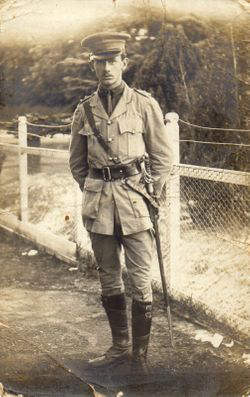
Driver William James Roseland – Rest in Peace.

Every year, around ANZAC Day, I share a thought on social media for my Great Grandfather William James Roseland, who perished in France during the ‘Great War’. The greatest sadness for me is the photo below, a loving father with his brand new baby boy who never saw each other again.

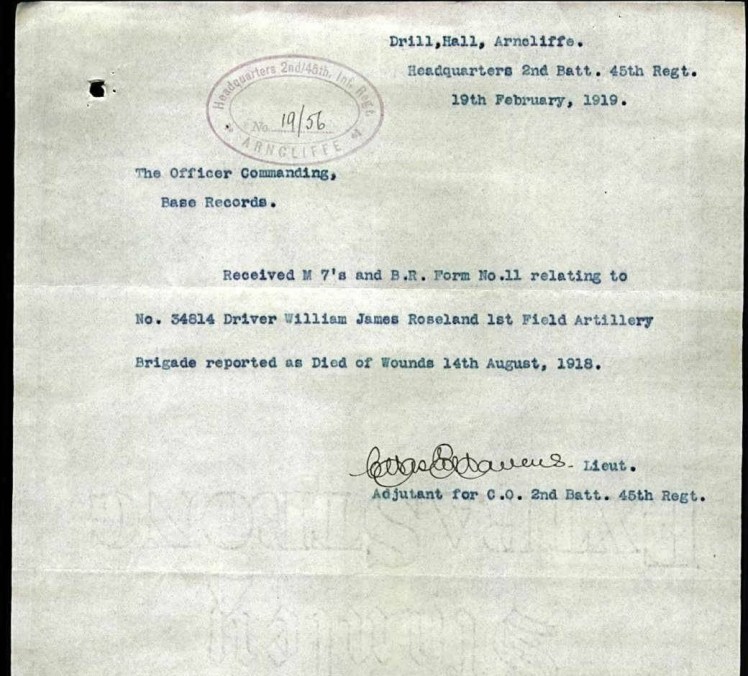
Today, August 14 2018, is the 100th anniversary of William’s death. A milestone I nearly missed if it wasn’t for my cousin John Francis Roseland (named after my mother Frances) who compiled the majority of the information that follows.

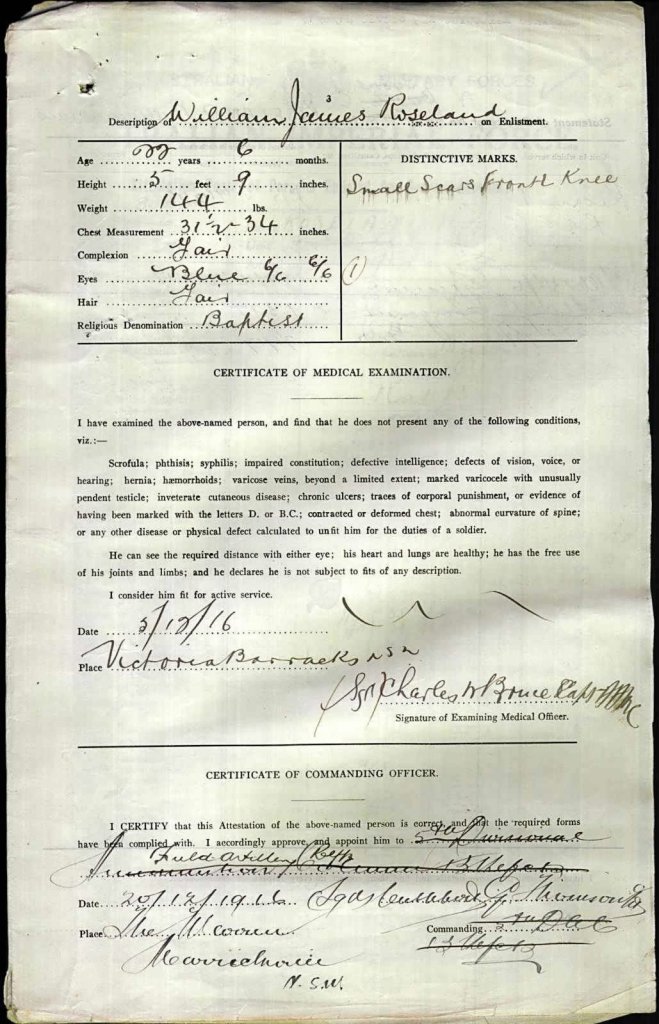
William James Roseland, born in Brisbane c1893, enlisted on the 7th December 1916 at the ripe old age of 22 and half years old.

He was 5 feet 9 inches tall at the time of his enlistment, weighed 144 pounds with a chest measurement of 31-34 inches and had fair hair and blue eyes.

His distinctive marks include small scars on his knee. I’m not sure how identifiable this would be for a casualty in battle though, but it was noted all the same. Like so many young men of this time it is believed that he was at least 2 years younger. Meaning he was possibly 21 when he died. You can see below the attestation of his enlistment papers – no date of birth is mentioned.

The only son of George and Margaret Roseland, William made his way to Sydney where he married Ruth Winifred Field, or ‘Nanny Field’ as we used to call her.

On April 19th 1917 he fathered his only child, a son, Ronald William Roseland – the baby in the picture at the beginning of this post – our grandfather and a man I loved dearly.

Just over a month later William embarked from Melbourne on board HMAT Suevic. He never saw his wife or son again. The boat traveled via South Africa, and with basic training along the way William soon found himself amongst the horrors of the western front.

As an engineer who had experience handling horses, William was given the rank of Driver. This meant he was in charge of a team of horses that pulled gun carriages in and out of the required locations.

A dangerous mission that left him undefended on many occasions.

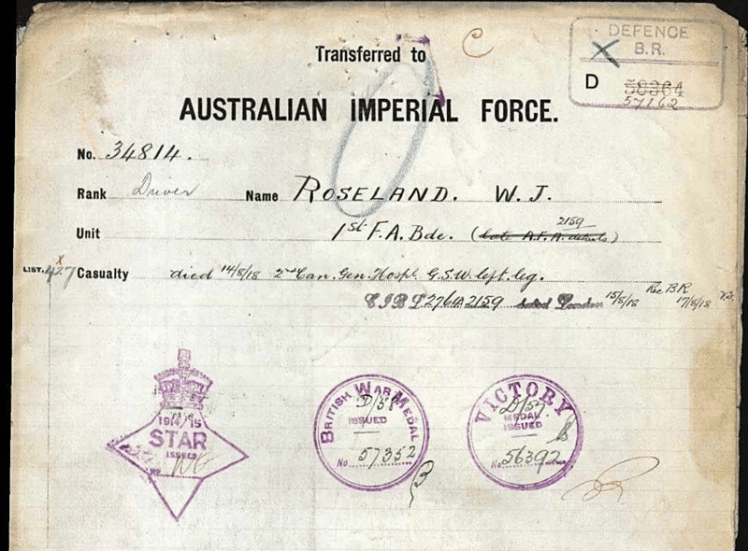
Medals Awarded

Medals Awarded

On the 10th of August 1917 Whilst undertaking one of these transports a shell exploded with in his vicinity, which caused some shrapnel to lodge in his leg. A note written by one of his brigade said” I saw Driver Roseland not long after taking the shrapnel to his leg. He was in fine spirits and was not in need of aid to walk to the triage station. “ Adrenalin is amazing, but eventually it wears off.

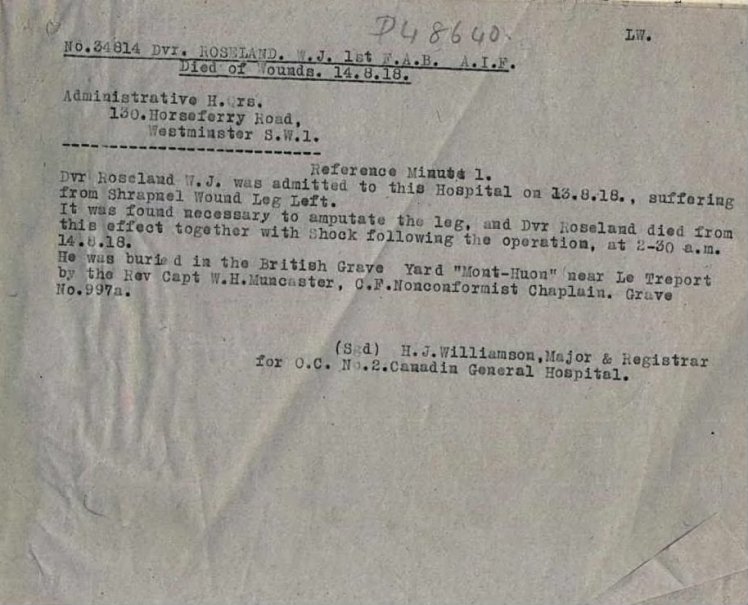
Unfortunately, there were no antibiotics at this time and within 2 days he was admitted to the 2nd Canadian General Hospital. Things then became critical with the leg turning gangrenous. His leg was removed however it was too late as sepsis had taken over his body. On this day 100 years ago he died in a faraway country with no family by his side.

He is buried in the Mont Huon Military Cemetery (Plot VII, Row A, Grave No. 2A), Le Treport, France.

Photo taken by my cousin Steven Roseland

Photo taken by my cousin Steven Roseland

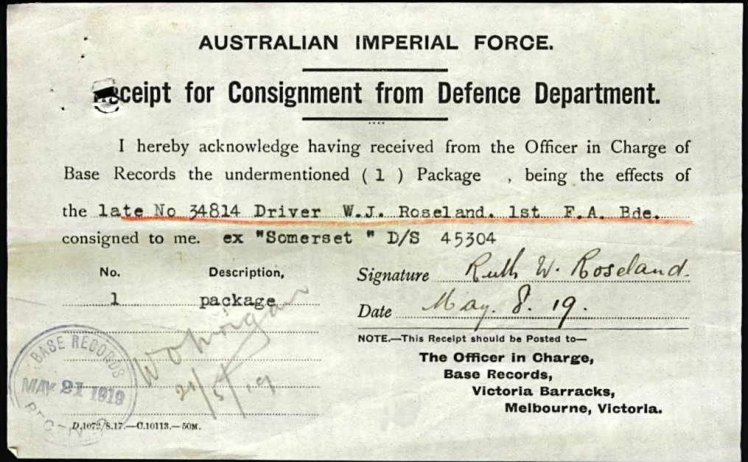
After his death my great grandmother was devastated. A young mother, with no income other than a war pension, wrote to the AIF desperately seeking her husband’s effects. Her penmanship is perfect, but the date is over nine months since William’s passing.

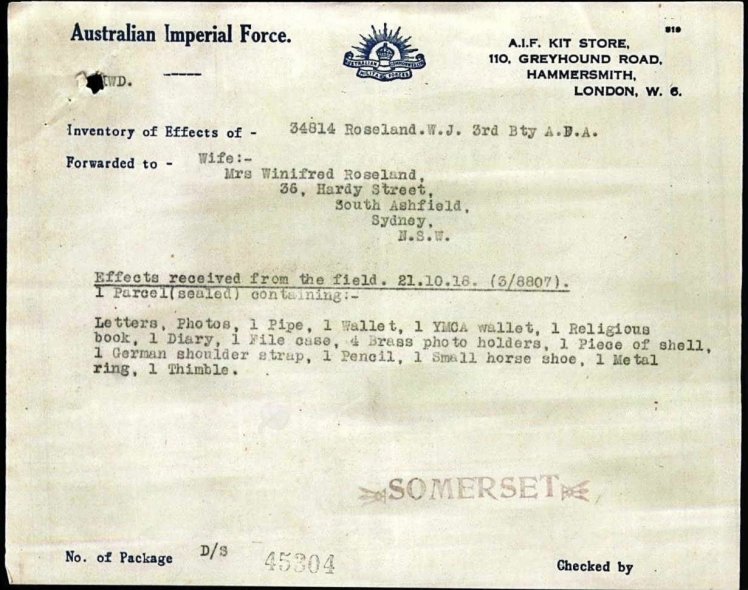
The reply is a sobering reminder of the futility of war.

A bible, a thimble, a wedding ring…William wasn’t sending much home other than his love.

I’d like to say that I miss William James, but I never had the opportunity to meet him. I did name my youngest son Lachlan James after him, in his honour. I did have the pleasure of knowing my great grandmother’s second husband, who we affectionately called Pop. He was a lovely man who died when I was very young. He was in his nineties and I was less than ten.

War is Hell, or so the saying goes. But Alan Alda said it best in an episode of MASH when his character, Dr Hawkeye Pearce suggested that war was worse. When he was questioned by Father Mulcahy how he arrived at that conclusion he asked who went to hell. Fr Mulcahy said that Hell was for sinners. Hawkeye said that, unlike Hell, innocent people died in war. I agree with Hawkeye, war is worse.

The Fate of Patrol Boat 813

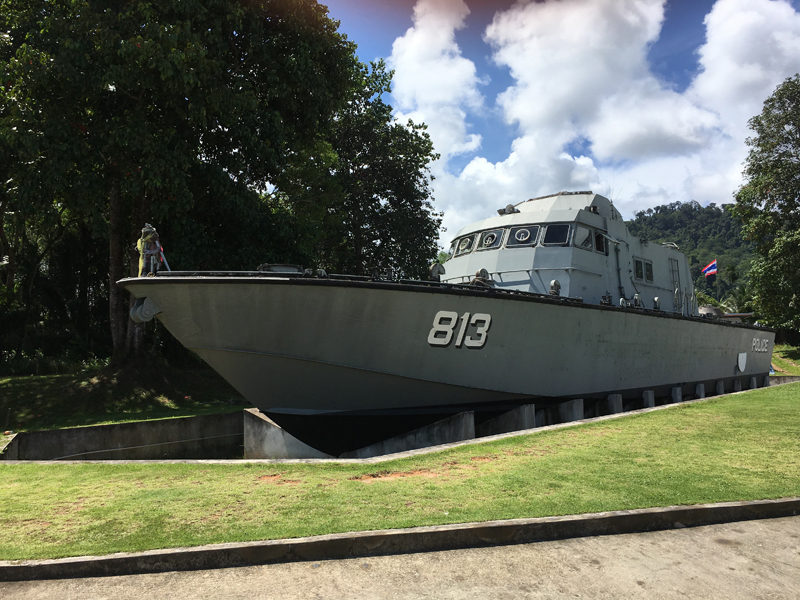
Patrol Boat 813 was built in 1994 and operated under Marine Police Station 1, Division 8 Marine Police Bureau, Pak Nam Sub-District, Mueang District, Ranong Province in the Kingdom of Thailand. The primary role of Patrol Boat 813 was to protect and secure the VIPs of the country and on the morning of the 26th December 2004 Patrol Boat 813 was anchored approximately one nautical mile offshore in front of the La Flora Resort in Khao Lak whilst Thai Prince Khun Poom Jensen was jet skiing.

Several hours earlier the third largest earthquake ever recorded on a seismograph struck off the west coast of Sumatra, Indonesia. The subsequent tsunami swept the Prince from existence and washed Patrol Boat 813 almost two kilometres inland killing the entire crew. Other members of the Royal Family were lucky to escape with their lives by sheltering in the upper floors of the resort.

Today the boat stands where the tsunami placed it and is kept as a sombre memorial to the estimated 227,898 people killed by the monstrous waves.

The Saddest, Most Beautiful Cemetery in the World

This article was originally published as six separate posts on Wish You Were Here. You can read them separately by clicking this link.


Late last year Heidi and I had a short break in Turkey and managed to spend a day at Gallipoli. It was a haunting experience filled with admiration for the soldiers of both sides who stepped up into a war they had no control over yet maintained their dignity and respect for each other, and a heavy sadness for the immense loss of life. Throughout this long post we will share information from the Commonwealth War Graves Commission and our images taken on the day, in the hope that we can convey to you the emotion of standing in the saddest, most beautiful cemetery in the world.

A good army of 50,000 men and sea power – that is the end of the Turkish menace. Winston Churchill, 1915

Ari Burnu

“Within days of the outbreak of the First World War in August 1914, both Australia and New Zealand began to raise forces to support the British Empire’s war effort. The first cohort sent to Europe was redirected to Egypt for initial training, arriving as early as December 1914. They were organised into a new formation: the Australian and New Zealand Army Corps, or ANZAC. This included the 1st Australian Division and the New Zealand and Australian Division, incorporating the New Zealand Infantry Brigade, the 1st Australian Light Horse Brigade and the New Zealand Mounted Rifles. Also attached to the corps were the 7th Brigade of Indian Mounted Artillery, and the Ceylon Planters Rifle Corps. Placed under the command of General William Birdwood, the ANZAC Corps was assigned to take part in the Allied amphibious landings which would begin on 25 April 1915.” Commonwealth War Graves Commission.

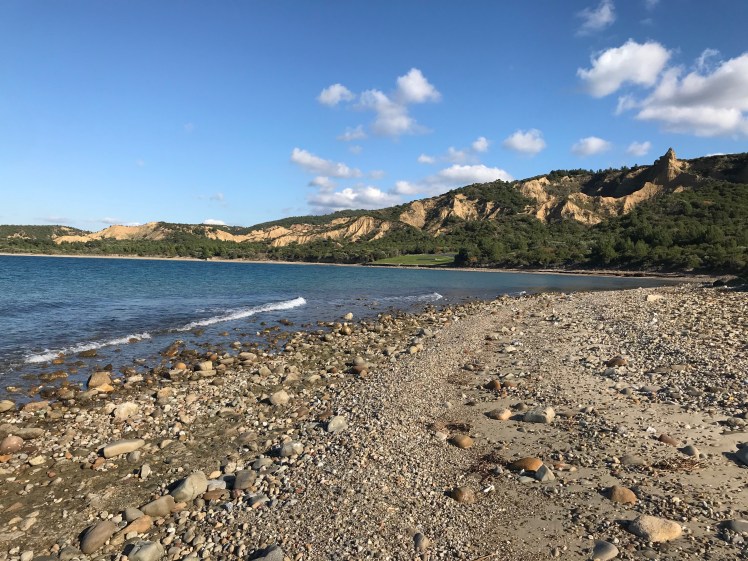
Beach at Ari Burnu

Beach at Ari Burnu

Standing on the beach at Ari Burnu where some 4,000 ANZAC troops came ashore on that first morning of the campaign was an eerie experience. In the relative silence of birdsong and lapping waves it was hard to picture the chaos of violence and death that once stained this unassuming little inlet. Our guide pointed out that in the darkness and confusion the ANZACs had come ashore at the wrong place. What should have been an easy run across flat fields was now an impossible landscape of deep gullies and high ridges.

“By nightfall over 16,000 troops were ashore, the beaches were full of wounded men, and those on the slopes were digging in. This area soon became known as ‘ANZAC’, and its features would be renamed by those living and fighting here: Shrapnel Valley, Plugges’s Plateau, Johnston’s Jolly, Happy Valley, Russell’s Top, the Nek, Walker’s Ridge, Lone Pine.” Commonwealth War Graves Commission.

The Target

Ari Burnu Cemetery was established within days of the first landing. Today there are 151 Australian soldiers, 35 New Zealand soldiers, 27 soldiers from the United Kingdom, 3 Indian soldiers and 37 unidentified bodies interred here.

The Cenotaph at Ari Burnu

ANZAC Cove

Those heroes that shed their blood
And lost their lives…
You are now lying in the soil of a friendly country.
Therefore rest in peace.
There is no difference between the Johnnies
And the Mehmets to us where they lie side by side
Here in this country of ours…
You, the mothers
Who sent their sons from faraway countries,
Wipe away your tears;
Your sons are now lying in our bosom
And are in peace.
After having lost their lives on this land
They have become our sons as well. – Mustafa Kemal Atatürk 1934.

Standing on the beach at ANZAC Cove you realise the hopelessness of the situation. Although the landscape in 1915 was devoid of trees (the majority of which had been cut down by local villagers over the years – mainly for firewood) it was still as steep and unforgiving as it is today. The lack of foliage may have facilitated troop movement for the ANZACs, but it also meant there was no cover from the Turkish resistance that was getting stronger every hour as reinforcements arrived. You can only wonder what was going through the mind of a young soldier as he clambered out of a leaky rowboat and started hurtling himself up a hill under fire from above.

Sphinx, Russell’s Top and Plugge’s Plateau in Black and White
Sphinx, Russell’s Top and Plugge’s Plateau today

“According to the article 2 of the Law on Administration of Provinces No. 5442 the Turkish Government has decided to name the coast that is located between the longitude 26 16 39 and the latitude 40 14 13 of the Gallipoli peninsula as ‘THE ANZAC COVE’ to the memory of those soldiers belonging to the Australian and New Zealand Army Corps (ANZAC) who landed here on 25 April 1915 during the campaign of Dardanelles which constitutes one of the most glorious wars on our history and whic (sic) also has an important place in world history.” Plaque laid at ANZAC Cove April 17th 1985 – Image below.

The Allied objectives in 1915 were simple. Land at Gallipoli, capture Istanbul and provide a supply route to Russia. This would have opened another front against Germany and its ally Austria-Hungary. It wasn’t to be.

“From the beach, groups of men rushed up steep, scrub-covered slopes towards the high ground. At first the few Turkish defenders were pushed back. Isolated groups of Australians and New Zealanders fought their way to where they could see the Dardanelles. As the day progressed Turkish resistance strengthened. By nightfall none of the objectives had been reached. The commanders on the spot recommended withdrawal but were ordered instead to dig in and hold on.” Gallipoli Peninsula Peace Park.

ANZAC Cove Today
ANZAC Cove Today

The beach head at ANZAC Cove was 600 metres long, but only 20 metres wide meaning that there was not much space to launch a successful military campaign. Supplies could only come in at night and they had to be carried via donkey to the front line. Casualties had to be evacuated the same way. Thousands of men lived in dugouts during the 240 day campaign coping with oppressive heat, freezing cold, swarms of flies, bully beef, artillery shells and sniper fire, at all times surrounded by the stench of death.

You have got through the difficult business, now you dig, dig, dig, until you are safe. General Sir Ian Hamilton. British commander-in-chief, Gallipoli.

As the ANZACs dug in for dear life the British landed at Cape Helles and were met by fierce Turkish resistance who kept the British pinned down on the tip of the peninsula. On the 6th May a combined assault using ANZACs, French and British troops was planned but little progress was made for the next two days. On the 8th May the ANZACs were ordered to push forward towards the village of Krithia. Unfortunately the enemy had set their own lines and over 1,000 Australians and 800 New Zealanders were killed or wounded.

Sir, this is a sheer waste of good men. Joseph Gasparich, New Zealand soldier, Krithia, 8 May 1915.

ANZAC Commemorative Site

On the 19th May the Turks mounted a counter attack. Wave after wave of Turkish soldiers slammed into the ANZAC trenches only to be met with such desperate and concentrated fire. At the conclusion of the battle 0ver 10,000 Turkish soldiers were wounded and approximately 3,000 lay dead. The ANZACs lost 160 dead and 468 wounded. Horribly, the dead Turks lay out on no mans land until the 24th May when a temporary truce was declared so that the bodies could be retrieved for burial.

The Sphinx
The Sphinx

“As the summer heat intensified, conditions on Gallipoli deteriorated. Primitive sanitation led to a plague of flies and the outbreak of disease. Thousands of men were evacuated suffering from dysentery, diarrhoea, and enteric fever…Men suffered particularly from lice in their clothing. Morale sank as the prospect of victory receded. Many came to feel they would never leave Gallipoli alive.” Gallipoli Peninsula Peace Park.

The stalemate remained for several months.

ANZAC
ANZAC